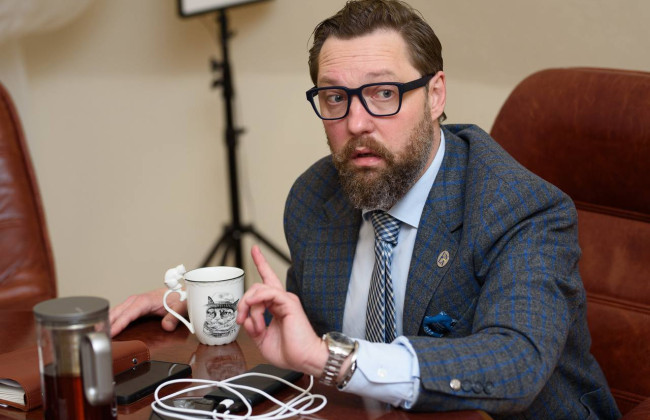
Competitive selection processes for leadership and administrative positions, particularly within the Specialized Anti-Corruption Prosecutor’s Office (SAPO), have become an indicator of the maturity of civil society and professional communities, and selection committees serve as a key mechanism for reforming state institutions. This opinion was expressed by Oleksiy Shevchuk, a lawyer and spokesperson for the National Bar Association of Ukraine, director of the Legal Information Center at the Law Institute of the Kyiv National Economic University named after Oleksiy Shevchuk, a lawyer, spokesperson for the National Bar Association of Ukraine, and lobbyist, in an interview with the “Judicial and Legal Gazette.” In December 2025, he was appointed to the selection committee authorized to screen candidates from among prosecutors for vacant administrative positions in the Specialized Anti-Corruption Prosecutor’s Office.
In an interview with the “Judicial and Legal Gazette,” Oleksiy Shevchuk criticized the obstruction of selection procedures in the justice sector and anti-corruption policy and pointed to systemic problems with launching competitive procedures in the justice sector and delays in forming the High Council of Justice.
You often speak about civil society’s participation in selection committees and supervisory boards. Why is this a matter of principle for you?
Because that is precisely where decisions are made that determine the quality of state institutions for years to come. If civil society truly wants change—it must be more than just a commentator on social media; it must be a full-fledged participant in selection and oversight mechanisms. Participation in selection committees, supervisory boards, and competitions for vacant positions is a practical way to exert influence, where competence, responsibility, and the ability to make decisions—rather than just offer opinions—are demonstrated.
You mentioned the story about the selection committee for forming the High Qualification Commission of Judges. What exactly is happening?
Just recently, I was appointed by the Ukrainian Bar Association to serve on the selection committee for forming the High Qualification Commission of Judges. And here lies the key problem: the High Council of Justice has still not formed the selection committee. This creates a paradox—a significant number of stakeholders have fulfilled their requirements: the Council of Prosecutors and the Ukrainian Bar Association have submitted candidates, and the procedures on their part have been completed. Yet the body responsible for the final formalization and launch is effectively stalling the process.
Why, in your opinion, is this issue so important right now?
Because we are living in conditions where the work of many institutions is blocked or slowed down. The judicial system, selection and evaluation bodies, and competitive selection processes for leadership positions—these are the “lifeblood” of the state. If it doesn’t work, the state loses its ability to govern, its credibility, and its capacity to reform. And competitive selection processes are a way to legally and transparently reset the system.
You also mentioned that there are competitions underway for the head of customs and for seats on supervisory boards. What’s the problem there?
The problem is that we hardly see any of the so-called “public opinion leaders” there—the very people who have been calling for “changing the system” for years. When it comes to taking responsibility—submitting applications, going through interviews, assuming legal risks, and adhering to work discipline—many are simply nowhere to be found. And then the obvious question arises: why?
And your answer is—that they lack competence?
I’m talking about a typical situation: some public activists lack specialized education, relevant experience, management skills, and—to be frank—often a proven track record of professional work. This isn’t an insult or a label. It’s a practical criterion. Selection committees aren’t about slogans. They require specific competencies: law, management, compliance, integrity, procedure, the ability to work with evidence, the ability to ask the right questions, and the ability to document positions.

You recently had an interview with the Council of Prosecutors of Ukraine, followed by your appointment as Prosecutor General to the commission on administrative positions at the Specialized Anti-Corruption Prosecutor’s Office (SAPO). What does this role entail?
It’s a role in which I effectively represent the bar as part of the justice system. And this is fundamental: the bar is not a mere outside observer, but an institution that works daily within legal proceedings and observes how the rights of the defense are upheld (or violated). The competition for administrative positions in the Specialized Anti-Corruption Prosecutor’s Office is complex, sensitive, and high-stakes, as it concerns the agency’s leadership functions and operational standards.
You emphasize the “balance” between the prosecution and the defense. How should this be reflected in the selection of prosecutors?
It’s very simple: in a democratic state governed by the rule of law, a prosecutor is not a “punishment manager” but a procedural guarantor of legality. Therefore, as a member of the selection committee, I must carefully examine whether candidates have been found to systematically disregard the rights of attorneys and their clients, whether they have shown contempt for the adversarial principle, and whether they have adhered to standards of ethics, procedural discipline, and integrity. Because administrative positions are not just about a career. They’re about the culture of the agency and the rules that extend to dozens of people.
How do you define the criteria for a “high-quality candidate” in such competitions?
The key elements are professionalism, integrity, and maturity. Professionalism is not just a degree, but practical experience, skills, and the ability to act within established procedures. Integrity means the absence of conflicts of interest, transparent finances, a good reputation, and a willingness to explain decisions. Maturity is the ability not to confuse a position with power, or authority with personal preferences or revenge. And, of course, the ability to withstand public scrutiny and pressure, because the anti-corruption hierarchy is always in the crosshairs.
You mention the obstruction of institutional work. Where, in your opinion, is the “bottleneck” in the system?
The bottleneck lies in initiating procedures and meeting deadlines. Some agencies formally declare their support for reforms but, through procedural delays or staffing issues, hold up decisions without which competitions cannot begin or be completed. This erodes trust and creates room for speculation: some claim that “everything has been rigged,” others say that “there are no candidates,” and the result is a country without fully functioning institutions.
What would you like to say to those who call themselves public figures and opinion leaders?
If you truly want change—get involved in the process. Apply to serve on a supervisory board. Apply to join a selection committee. Go through the interview process. Take on the responsibility, the conflict, the public scrutiny, and the work “on the ground.” Because it’s easy to influence public opinion from a phone. Working within the institutional framework is difficult. But that’s exactly where real change happens.
And what advice would you give to professional communities—lawyers, academics, and administrators?
Don’t stand on the sidelines. Professional communities should not only nominate candidates but also publicly demand adherence to procedures, deadlines, and transparency. If we’ve already nominated candidates and done our part, we have the right to ask direct questions of those who are delaying or blocking the next step.
What is your main message to conclude?
Selection committees are not just for show. They are a mechanism that determines whether the country will have professional and accountable institutions or whether it will continue to exist in a state of “endless restart” without any results. Today, it is critically important that selection committees begin functioning—both for the High Council of Justice and for administrative positions in the Specialized Anti-Corruption Prosecutor’s Office, as well as in other key sectors. Because without this, we are effectively consenting to the paralysis of the state apparatus.
Author: Oleksiy Shevchuk, Attorney and Partner at Barristers
Source: https://sud.ua/uk/news/publication/351829-konkursnye-komissii-eto-ne-dekoratsiya-advokat-i-chlen-konkursnoy-komissii-po-otboru-rukovodstva-sap-aleksey-shevchuk