In our previous article, we examined the alarming trend of turning exceptional legal instruments into systemic practice by analyzing the use of excessive bail amounts. Continuing this theme, we will focus on another, no less threatening phenomenon—the abuse of the emergency search mechanism provided for in Part 3 of Article 233 of the Criminal Procedure Code of Ukraine (hereinafter—the CPC of Ukraine).
What was intended by the legislature as an emergency measure for extraordinary situations is increasingly becoming a routine tool for circumventing the standard procedure for obtaining a court warrant to conduct numerous unjustified searches. This not only poses risks to the inviolability of a person’s home or other property but also raises a serious legal issue regarding the status of property seized during such searches, effectively depriving its owners of effective legal remedies.
The right to the inviolability of one’s home or other property is one of the fundamental rights enshrined in Article 30 of the Constitution of Ukraine. This provision is a direct guarantee of the protection of an individual’s private sphere against arbitrary interference by the state.
The Code of Criminal Procedure of Ukraine elaborates on this constitutional provision; specifically, Part 1 of Article 233 of the CPC of Ukraine states that no one has the right to enter a person’s home or other premises except with the voluntary consent of the person who owns them or on the basis of a ruling by an investigating judge.
At the same time, Part 3 of Article 233 of the CPC of Ukraine establishes an exception to this general rule. It allows an investigator, an inquiry officer, or a prosecutor to enter a person’s home or other premises prior to the issuance of a ruling by an investigating judge only in “urgent cases.” The law provides an exhaustive list of such cases:
- 1. Saving human lives and/or property;
- 2. The immediate pursuit of a person suspected of committing a criminal offense.
A key element of this provision is its exceptional nature. The legislature deliberately limited the possibility of conducting a search without prior judicial authorization to only two exceptional situations where delay could lead to irreversible negative consequences. After conducting such an urgent investigative action, the pretrial investigation authority is required to immediately apply to an investigating judge for a search warrant to legalize the search. Failure to do so renders any evidence obtained as a result of such a search inadmissible.
Given the broad scope for interpreting the concepts of “urgency” and “preservation of property,” the Supreme Court plays a key role in establishing a uniform body of case law. An analysis of its legal positions allows for the establishment of a standard by which the actions of law enforcement officers should be evaluated.
In its decisions, the Supreme Court has emphasized that the concept of “property” in the context of Part 3 of Article 233 of the Code of Criminal Procedure is interpreted more broadly than its definition under civil law. It encompasses not only valuables but also any tangible objects that could potentially serve as physical evidence in criminal proceedings. Thus, “preservation of property” may also include preventing the destruction of evidence.
However, this broad interpretation does not constitute a license for arbitrariness. The Supreme Court has established a strict criterion for applying this ground: the prosecution must prove the existence of an “obvious and real threat” of the destruction or loss of evidence. This means that at the time of entering the residence, the investigator must have specific, objective evidence indicating that any delay required to obtain a warrant from an investigating judge would inevitably make it impossible to secure this evidence. Hypothetical assumptions or general statements such as “the suspect may destroy evidence” are insufficient. The motion and the supporting materials must clearly justify why the threat was perceived as real at that specific moment.
Essentially, the Supreme Court requires investigating judges to exercise careful oversight and verify whether the prosecution had an objective opportunity to apply for a search warrant in advance. If the investigating judge determines that there were no grounds for an urgent search, he or she is obligated to deny the motion. In such a case, in accordance with the “fruit of the poisonous tree” doctrine, all evidence obtained during such an unlawful search, as well as evidence derived from it, is deemed inadmissible.
Furthermore, the Supreme Court emphasizes the importance of complying with the requirement to file an “urgent” petition with the court after the search has been conducted. Failure to comply with this requirement without valid, objective reasons constitutes an independent ground for refusing to legalize the search and for declaring the evidence inadmissible. Thus, the Supreme Court establishes a high standard of proof for the prosecution and requires investigating judges to play an active role in protecting constitutional rights, rather than passively validating the actions of law enforcement officers.
(Resolution of the Pre-Trial Chamber of the Supreme Court dated October 7, 2024, in Case No. 466/525/22 (Proceedings No. 51-7310kmo23)
To verify the compliance of actual judicial practice with established theoretical standards, an analysis was conducted of the 25 most recent rulings by investigating judges of the Pecherskyi, Sviatoshynskyi, Shevchenkivskyi, and Solomianskyi District Courts of Kyiv (a total of 100 decisions), published in the Unified State Register of Court Decisions following the consideration of motions to conduct searches, in accordance with Part 3 of Article 233 of the Criminal Procedure Code of Ukraine”
At first glance, the aggregate data confirm the thesis stated at the beginning of this report: an instrument that is exceptional in nature has become a widespread phenomenon, one that, in the overwhelming majority of cases, finds support in the courts.
Table No. 1. General statistics on the consideration of motions for urgent searches (city of
|
Indicator |
Value |
|
Total number of cases considered by the courts |
100 |
|
Motions granted |
75 |
|
Motions denied |
25 |
|
Overall percentage of granted motions |
75% |
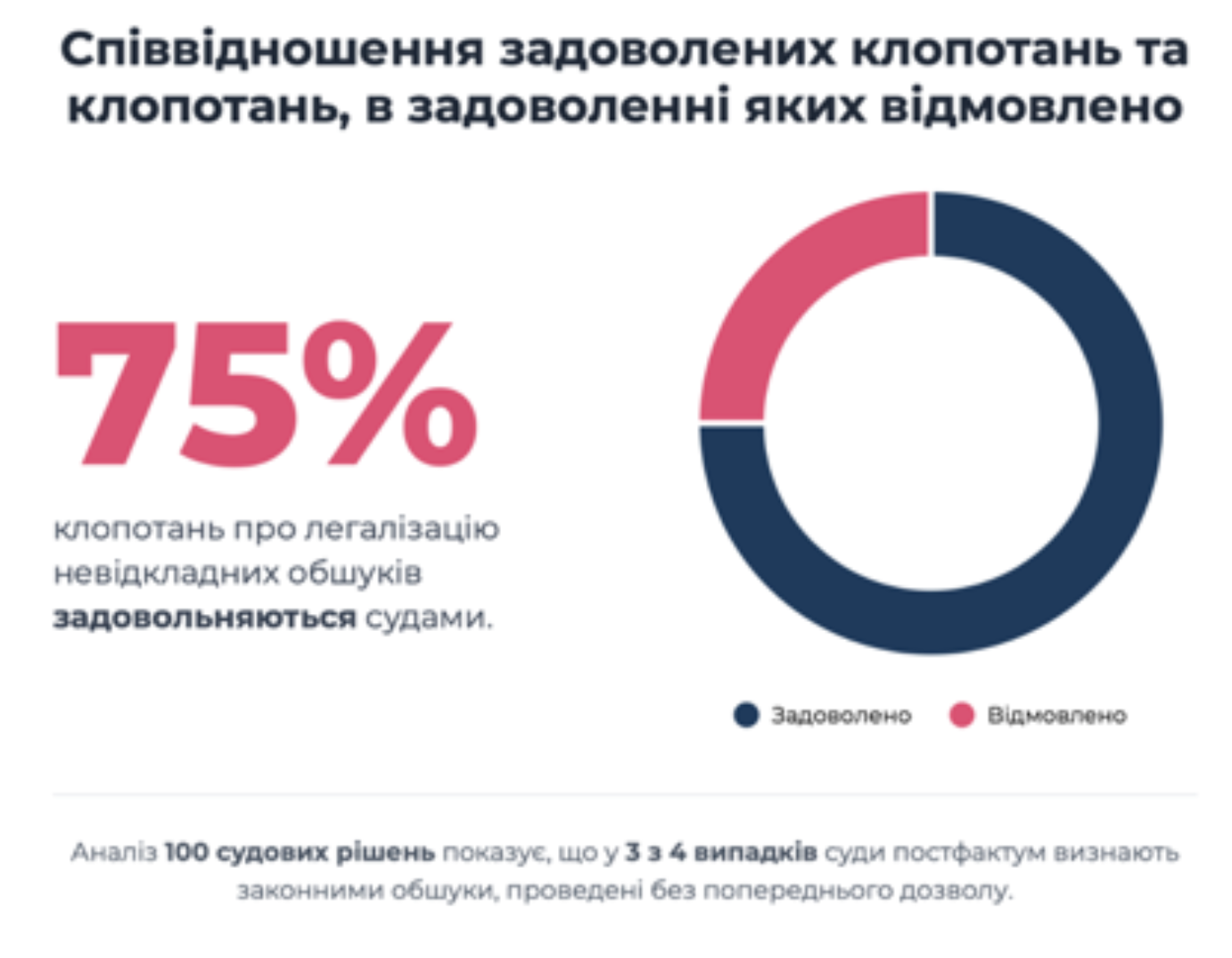
The overall approval rate of 75% indicates that in three out of four cases, investigating judges legalize searches conducted without prior authorization.
Such a high rate may indicate either the impeccable work of pretrial investigation authorities, who use this tool only when there are genuine grounds, or, more likely, to a tendency toward a formalistic approach on the part of some judges, who are inclined to accept the prosecution’s arguments regarding the existence of “urgent” circumstances. However, the aggregated data conceal a much deeper and more alarming problem, which becomes evident upon a detailed analysis of the practices of individual courts.
The distribution of outcomes for these motions across the capital’s various district courts demonstrates a striking lack of a uniform approach to applying the same legal provision. The level of protection for the constitutional right to the inviolability of the home effectively becomes a “lottery.”
Table No. 2.
|
Court |
Total Cases |
Granted |
Denied |
Percentage of cases granted |
|
Pecherskyi District Court of Kyiv |
25 |
24 |
1 |
96% |
|
Svyatoshyn District Court of Kyiv |
25 |
20 |
5 |
80% |
|
Shevchenkivskyi District Court of Kyiv |
25 |
18 |
7 |
72% |
|
Solomyanskyi District Court of Kyiv |
25 |
13 |
12 |
52% |
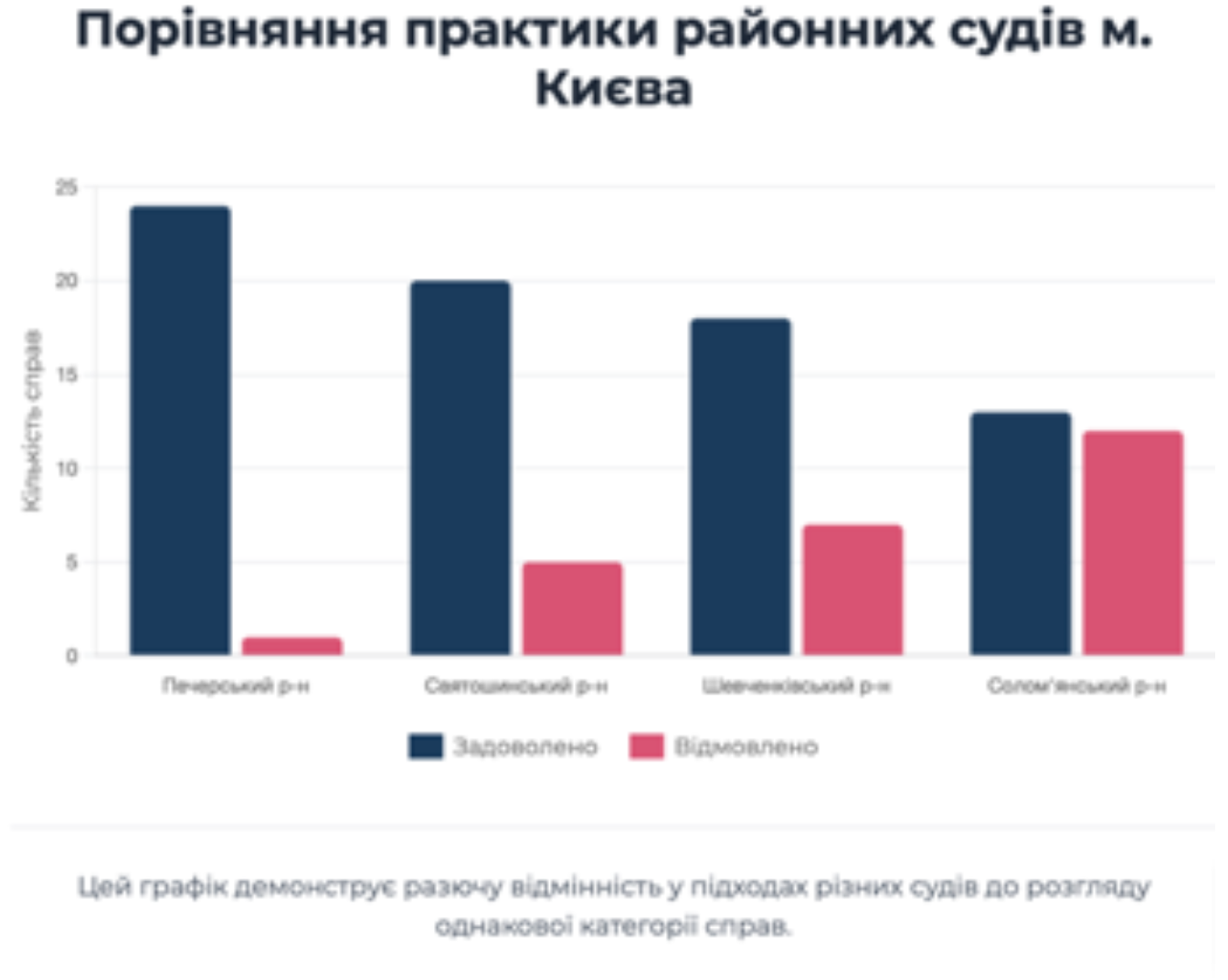
The data in Table 2 speak for themselves. On the one hand, the Pecherskyi District Court demonstrates loyalty to law enforcement motions, granting 96% of motions filed by pretrial investigation authorities. This creates the impression that judicial oversight in this court is largely formal, and that investigating judges act as passive observers.
Against this backdrop, the practice of the Svyatoshyn District Court appears somewhat ambiguous. On the one hand, the 80% rate of granted motions is still high and indicates significant trust in the prosecution’s arguments. On the other hand, the fact that one in five motions is denied demonstrates that judicial oversight here is not purely formal, and judges do analyze the grounds for conducting an urgent search. Thus, this court takes a middle ground, demonstrating neither excessive leniency nor exceptional strictness toward such motions filed by the prosecution.
On the other hand, the practice of the Shevchenkivskyi and Solomianskyi District Courts differs radically from that of the Pecherskyi District Court. In the Shevchenkivskyi Court, nearly one in four motions is denied. In the Solomyanskyi Court, however, the rejection rate is the highest, reaching 48%; that is, the investigating judges of this court reject and grant motions by the prosecution at nearly equal rates.
Such a striking difference in these figures cannot be explained solely by variations in the quality of law enforcement agencies’ work across different city districts. Clearly, the key factor is the stance of the investigating judges and the depth of the judicial review they conduct. This fully confirms the assumption that in some courts, investigating judges take a more thorough approach to reviewing whether there are grounds for granting such motions. The existence of such divergent standards of justice within a single city is a systemic problem that undermines the principles of legal certainty and equality before the law and the courts.
Regarding the legal status of seized property: a legal trap for property owners.
One of the most complex legal conflicts arising from the abuse of the emergency search mechanism is the issue of the legal status of seized property. This problem creates a “procedural trap” that effectively deprives the owner of the opportunity to defend their rights.
In practice, investigators and prosecutors often argue that property seized during an emergency search that was subsequently “legalized” by an investigative judge’s ruling, is not temporarily seized property within the meaning of Article 167 of the Code of Criminal Procedure of Ukraine. The logic of their argument is as follows: since the investigating judge’s ruling retroactively authorizes the search, which lists the items and documents to be located, this same ruling allegedly automatically authorizes their seizure as well. Accordingly, the requirements of the Code of Criminal Procedure of Ukraine regarding the need to file a motion with the court for the seizure of such property do not apply.
This position is profoundly flawed and contradicts both the letter and the principles of criminal procedural law. It is based on a conscious or unconscious conflation of two procedural institutions that are entirely different in their legal nature and purpose: the search and the seizure of property.
The key to understanding the issue lies in clearly distinguishing the purposes of these two procedural actions.
- The Purpose of a Search (Art. 234 of the Code of Criminal Procedure of Ukraine). A search is conducted for the purpose of identifying and documenting information, locating instruments of a crime or property obtained by criminal means, and determining the whereabouts of wanted persons. A search warrant, pursuant to Article 235 of the CPC, grants the right to enter a person’s premises and search for specific items. It constitutes judicial authorization to interfere with the right to the inviolability of the home, but not to restrict the right to property.
- The Purpose of Property Seizure (Article 170 of the Code of Criminal Procedure of Ukraine). Property seizure is a measure to secure criminal proceedings, consisting of the temporary deprivation of the right to dispose of, manage, and/or use property. Its purpose is to preserve physical evidence and to ensure the possibility of confiscation, special confiscation, or a civil claim. A ruling on the seizure of property is the only judicial decision provided for by the Code of Criminal Procedure that is directly aimed at restricting a person’s right to property.
Thus, a search warrant (even if issued after the search has already been conducted) merely legalizes the fact of interference with an individual’s private sphere. It cannot serve as a substitute for a ruling on the seizure of property, which requires a separate judicial proceeding in which the court must assess the proportionality of such an interference with property rights and strike a “fair balance” between the interests of the investigation and the rights of the owner. Any other interpretation directly contradicts Article 16 of the Code of Criminal Procedure of Ukraine, which requires that restrictions on property rights be imposed exclusively on the basis of a reasoned court decision issued in accordance with the procedure provided for by the Code.
The prosecution’s flawed concept creates a dangerous legal vacuum. If property seized during a search is not considered temporarily seized, its owner is deprived of all procedural tools for protecting their rights as provided for by the Code of Criminal Procedure:
- The right to object to the seizure of property during the consideration of the relevant motion.
- The right to file a motion to lift the seizure if it is no longer necessary.
- The right to challenge the investigator’s inaction regarding the failure to return temporarily seized property in accordance with Article 303 of the Code of Criminal Procedure of Ukraine.
The owner finds themselves in a situation where their property is being held by the state indefinitely, without a direct court order authorizing such detention, and without any effective procedure for appeal. This is unquestionably a violation of the right to a fair trial and an effective remedy.
The correct approach, consistent with the objectives of criminal proceedings, is that any property seized during a search acquires the status of temporarily seized property from the moment of its actual seizure. Even if authorization to seize this property was expressly granted in the investigating judge’s ruling, it is subject to the regime governing temporarily seized property. This position is also supported by the practice of the High Anti-Corruption Court, specifically in its ruling of August 3, 2021, in Case No. 991/5144/21.1
Based on this analysis, the following practical recommendations can be formulated to protect individuals’ right to peaceful possession of property:
- During a search, it is necessary to insist that detailed remarks regarding the absence of grounds for an urgent entry be included in the search report. You should require the investigator to clearly articulate what exactly constituted the “real and obvious threat” of evidence destruction that made it impossible to wait for a court decision. Documenting the absence of such reasoning in the report will serve as a solid foundation for a subsequent appeal.
- After the property has been seized. If the investigating judge has nevertheless authorized the search, and the prosecution does not file a motion to seize the seized property within 48 hours, the most effective course of action is to immediately file a complaint regarding the inaction of the investigator/prosecutor under Article 303 of the Criminal Procedure Code of Ukraine. The grounds for the complaint should be based on the fact that any seized property is temporarily seized, and a ruling authorizing a search cannot serve as a substitute for a ruling to seize the property.
Only a comprehensive approach—combining strict adherence to procedural safeguards by investigating judges, an active stance by the defense, and systemic changes in law enforcement practices aimed at unifying practice and enhancing its consistency— can restore the institution of the urgent search to its original exceptional framework and ensure effective protection of the right to property and the inviolability of the home in criminal proceedings.
Author: Dmytro Zelenyuk, Barrister
Source: https://protocol.ua/ua/nevidkladniy_obshuk_v_poryadku_ch_3_st_233_kpk_vinyatok_shcho_stav_pravilom/