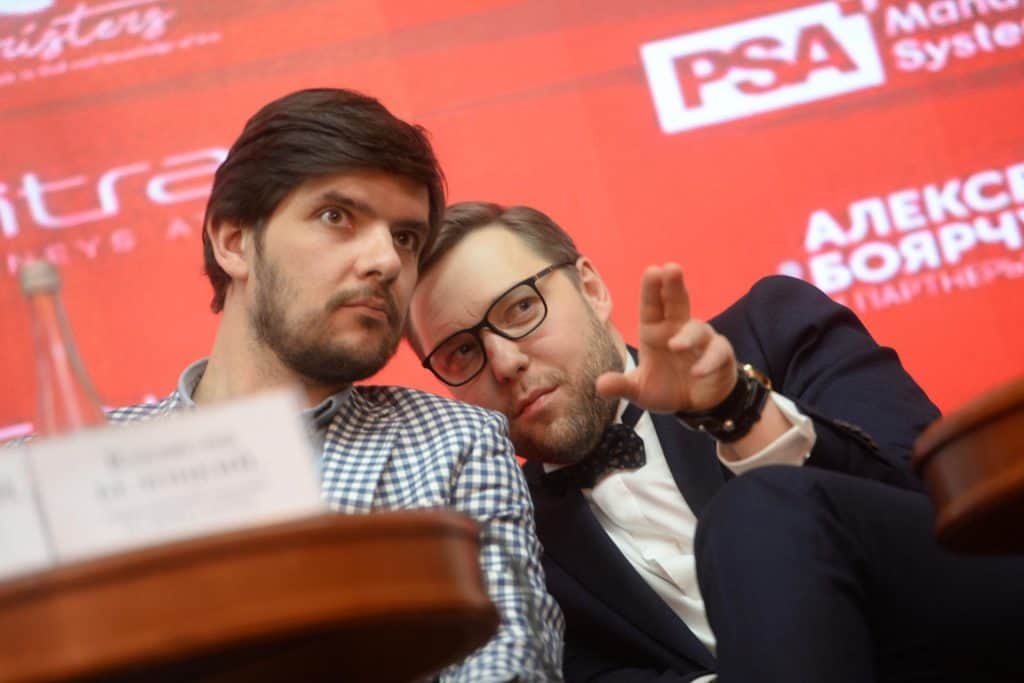
"We don't just work—we live and breathe this"—that's the main difference between the "new school" and the "old school," said Oleksiy Shevchuk, a partner at Barristers Law Firm, on the first day of PLS-2018 during a discussion on the conflicting approaches to work between the new and old schools of lawyers.
The organizers of the 6th International Forum on the Promotion of Legal Services (PLS-2018) continue to experiment with new formats. The fourth session, or “Mortal Kombat,” was held under the provocative title “Conflict of Approaches: Young Warriors vs. the Gods.” The “Mortal Kombat” session was moderated by Rustam Kolesnik, editor-in-chief of the newspaper “Yuridicheskaya Praktika,” and Serhiy Sachenko, director of IT projects at the “Yuridicheskaya Praktika” publishing house.
Representing the classical school were Mikhail Dubinsky, managing partner of the law firm "Dubinsky & Osharova," Oleksiy Kot, managing partner of Antika Law Firm, Yaroslav Romanchuk, managing partner of EUCON Legal Group, and Denis Bugay, partner at VB PARTNERS Law Firm. The new approach was demonstrated by Oleg Gromovoy, managing partner of GENTLS Law Firm; Vladislav Bilotsky, managing partner of BERYLSTONE LLP; Oleksiy Shevchuk, partner at Barristers LLP and attorney Oleksiy Shevchuk, and partner at QUANTUM ATTORNEYS Maksym Andrianov.
Speaking about the idea behind the new format, Kolesnik noted that there are three “old school” waves, all united by one thing: representatives of all three waves are familiar with the corporate culture of large law firms. In 2013–2014, law firms began to emerge not from alumni of large firms, but from groups of like-minded individuals. They were quite aggressive toward the “old school.” Which methodological approach—old school or new school—will prove most viable?
“We don’t just work—we live this”—that’s the main difference between the ‘new school’ and the ‘old school,’ according to Oleksiy Shevchuk. Another point is the use of non-legal methods in the legal business. “We use what the ‘old school,’ in the classical sense, does not use,” the speaker noted, referring to the media and civil society organizations. “Don’t you think that in that case, you’ll burn out professionally faster?” Serhiy Sachenko asked the speaker. “If I burn out four years sooner, then so be it!” replied Shevchuk, adding that he would find other areas for self-fulfillment.
Mykhailo Dubinsky noted that the problem of professional burnout in the legal profession is very acute. “Dubinsky & Osharova” is one of the best firms specializing in intellectual property rights. What is the key to success? “My position is simple: you have to be the best in every role,” emphasized Mr. Dubinsky. He outlined specific stages of business succession: first, certain functions are transferred; then decisions are made; and finally, responsibility is delegated.
“What is the essence of marketing?” Rustam Kolesnik asked the “left wing” (“young warriors”). “When we talk about marketing, we often mean the form and very rarely the content,” replied Oleg Gromovoy. “Banners, boxes, brochures—that’s the form. And that’s the main mistake—too much time is spent on the form. A logo and catchphrases may warm the heart of a managing partner playing to his own ambitions, but the client needs a high-quality service.”
“Modern clients in the information society need media-savvy lawyers,” says Mr. Shevchuk, emphasizing that his task as a leader is to make lawyers media-savvy. Vladislav Bilotsky, for example, discusses work matters with a client while playing PlayStation.
“Is the client a client of the law firm or a client of the company?” Mykhailo Dubynskyi asked the young lawyers. Mr. Gromovoy provided the answer to this question: “A client goes to court with a lawyer, not with a company.”
New leaders are emerging, and this will spur the “old school” to move faster. Denis Bugay emphasized this point. “Price dumping doesn’t work when it comes to a serious client. The client pays for the overall mindset—for the lawyer to steer their ship in the right direction. They won’t pay just to play PlayStation or drink whiskey. They already have people to do that with,” Mr. Bugay emphasized.
Those new ideas that the “young warriors” are talking about are, in Oleksiy Kot’s opinion, just the same old ideas repackaged. He stressed that it’s unlikely you can surprise a client with anything these days, and agreed with Mr. Bugay that price dumping won’t work with a serious client. Oleksiy Shevchuk agreed with Kot that methods once forgotten have now been significantly improved.
“Do you feel you have an advantage over your senior colleagues in a crisis?” Mr. Sachenko asked Maxim Andrianov. He replied that he did not feel such an advantage. The advantage lies elsewhere—in focusing on a particular practice area and increasing the number of clients. “We don’t enter sectors where banks already have good consultants,” emphasized Mr. Andrianov.
“In any case, your era will come to an end,” Mr. Kolesnik said, addressing the “right wing” (representatives of the “old school”). Not anytime soon, mind you—in about ten years—but generational change is inevitable.
Yaroslav Romanchuk emphasized that trust between the lawyer and the client is paramount. If there is trust, there is confidence, and only then can results be achieved. Speaking about burnout, Mr. Romanchuk noted that he doesn’t have time to burn out professionally: he needs to work, treat those who are burning out, and rest.
In parallel with the discussion, a vote was held on the question, “Which strategy is more appropriate?” The majority of PLS-2018 participants voted for the classical school—56% (44% supported the new approach).
Author: pravo.ua
Source: