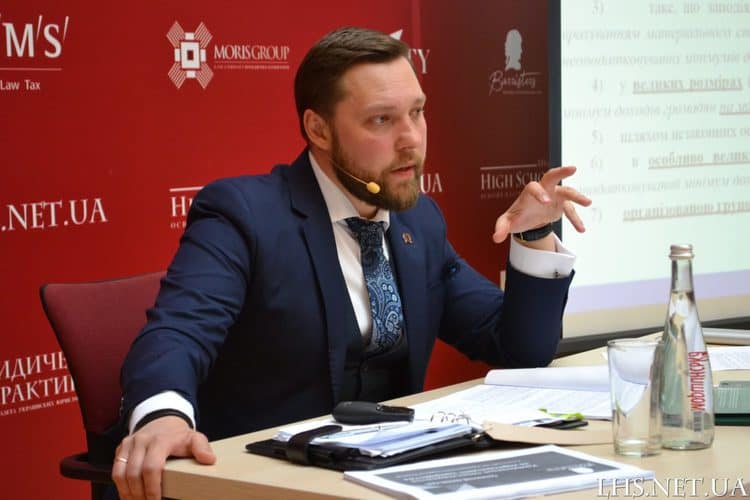
Oleksiy Shevchuk, a partner at Barristers, LLC, spoke to the LHS audience about the specifics of criminal prosecution for corporate fraud
Oleksiy Shevchuk, a partner at Barristers Law Firm, spoke to students at the Legal High School’s Criminal Practice Program about the nuances of criminal prosecution for corporate fraud (Articles 190 and 191 of the Criminal Code of Ukraine).
The situation regarding Articles 190, 191, and 364 of the Criminal Code of Ukraine within law enforcement agencies is critical. When assessing the need to apply a particular article, it may turn out that a person’s actions do not constitute any of these crimes at all.
Mr. Shevchuk highlighted, among the elements necessary to classify an offense as fraud, the victim’s direct participation in the transfer of property and the voluntary nature of the victim’s actions regarding the transfer of property or rights to it, as well as the mandatory use by the guilty party of deception or abuse of trust specifically to acquire property or rights to property, and not for any other purpose.
As an example, the lecturer cited the ruling of the High Specialized Court for Civil and Criminal Cases dated February 18, 2016, in case No. 5-281km16, in which, while upholding the acquittal under Article 190 of the Criminal Code of Ukraine, the High Specialized Court of Ukraine noted that fraud consists of the unlawful appropriation of property or the acquisition of rights to it by deceiving the victim or abusing their trust, and the case file shows that the prosecution did not charge the defendant with committing anyactions specifically aimed at misappropriating state funds by deceiving a specific official authorized to represent the interests of the state—which is a mandatory element for classifying a person’s actions under Article 190 of the Criminal Code of Ukraine.
In practice, crimes under Article 191 and Article 364 of the Criminal Code of Ukraine share many common characteristics, and it is necessary to distinguish between them, although this may seem difficult at first glance.
One distinguishing feature, for example, is that abuse of official position in the commission of a crime under Article 191 of the Criminal Code of Ukraine constitutes a means of embezzling another’s property, whereas in the case of abuse of official position for which liability is provided for under Article 364 of the Criminal Code of Ukraine, the public official does not embezzle another person’s property but, by acting contrary to the interests of the service and unlawfully deriving benefit from their official position, causes property damage to the owner.
Oleksiy Shevchuk advised paying attention to the ruling of the Supreme Court of Ukraine dated January 23, 2014, in Case No. 5-48ks13, which states that the embezzlement of another person’s property through abuse of official position may be committed by a guilty public official, including by instructing a subordinate to issue or transfer property to a third party.
The pretrial investigation of criminal offenses under Articles 190 and 191 of the Criminal Code of Ukraine is conducted by investigators from the National Police of Ukraine, the National Anti-Corruption Bureau of Ukraine (NABU), or other agencies. If necessary, the lecturer recommends changing the jurisdiction of the investigation—for example, in the case of a crime under Article 191 of the Criminal Code of Ukraine—by submitting a corresponding, well-reasoned motion to the Prosecutor General, his deputy, or the head of a higher-level prosecutor’s office.


Author: Legal High School
Source: