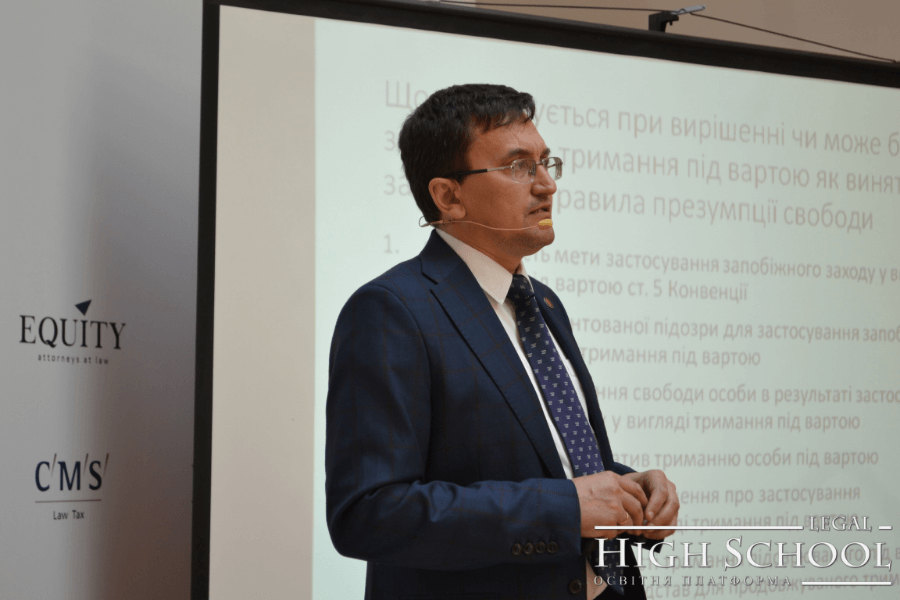
Mykola Ivanovych Pashkovsky – Candidate of Legal Sciences, Associate Professor, Legal Advisor at Barristers, LLC, member of the Scientific Advisory Council at the Supreme Court, spoke to students at the LHS School of Criminal Practice about current practices regarding the extension of pretrial detention periods
Deciding whether to extend the period of pretrial detention requires the same level of care as determining the appropriate preventive measure.
Pretrial detention involves a restriction on the most fundamental constitutional right—personal freedom and inviolability. Mykola Pashkovsky noted that one of the landmark rulings concerning Ukraine is the “Kharchenko v. Ukraine” decision, which systematically catalogs all violations in our country regarding pretrial detention and the extension of pretrial detention periods. Such issues typically generate significant public attention and active discussion on social media.
The lecturer drew attention to another relevant decision of the European Court of Human Rights in the field of criminal proceedings—the decision of December 15, 2016, in the case of “Ignatov v. Ukraine” (application No. 40583/15), which, in particular, noted that the State of Ukraine had failed to take the necessary measures to remedy violations regarding the extension of pretrial detention periods, a point already addressed by the European Court in its judgment in “Kharchenko v. Ukraine.”
Regarding the ECHR’s case law on the standards governing the application (including the extension) of pretrial detention, Mykola Pashkovsky focused on several key principles: proportionality, reasonable suspicion, the presumption of liberty, legality, and the reasonableness of the judicial decision.
Article 5, paragraph 1, of the Convention for the Protection of Human Rights and Fundamental Freedoms states: “Everyone has the right to liberty and security of person. No one shall be deprived of his liberty except in such cases and in accordance with such procedures as are provided by law….” Therefore, the lecturer emphasized that deprivation of liberty is such a severe measure that its application can be justified only if other, less severe measures have been considered and found to be insufficient to safeguard individual and public interests.
The lecturer noted that when deciding whether to apply pretrial detention as an exception to the general rule of the presumption of liberty, several factors are taken into account. First among these is whether the purpose of applying pretrial detention as a preventive measure complies with Article 5 of the Convention and whether there is reasonable suspicion to justify such a measure. Other factors taken into account include the grounds for depriving a person of liberty as a result of applying this preventive measure, the identification of alternatives to pretrial detention, and other relevant factors.
Mykola Pashkovsky discussed each component of the legality of pretrial detention: the openness of the court proceedings, their oral nature, the implementation of the adversarial principle, and others. The lecturer also noted that the ECHR has not specified timeframes or formats for ensuring access to case materials, but in any event, such access must be provided.
The lecturer also cited several examples of specific procedural situations involving the extension of pretrial detention, which have been developed and are implemented in the legal practice of Barristers Law Firm. For example, a specific case regarding the particularities of applying the judgment in the case of “Ruslan Yakovenko v. Ukraine” (Application No. 5425/11) in judicial practice.

Subscribe to the official YouTube channel of Barristers JSC: https://www.youtube.com/channel/UC47FmPpY-sIX-A18jf1WXvg—there will be plenty of interesting content
Author: Senior Attorney, Attorney-at-Law Trainee, Research Advisor Mykola Ivanovych Pashkovsky
Source: