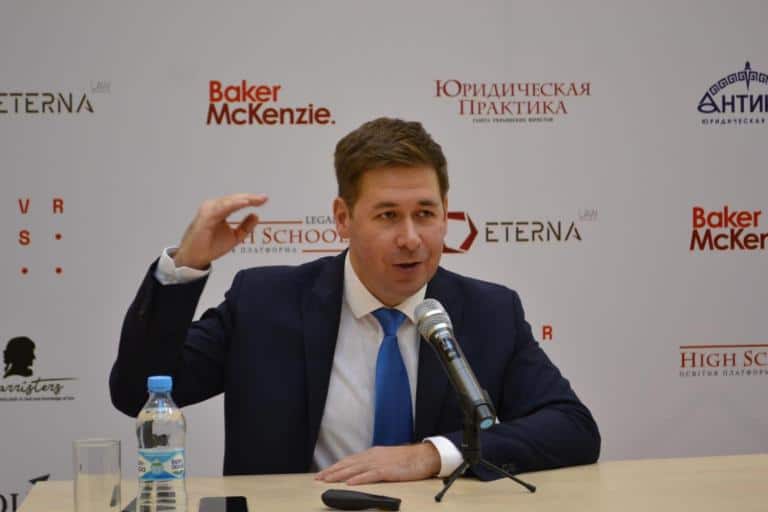
LHS students explored the advantages and disadvantages of a jury trial during a workshop led by Ilya Novikov, a partner at BARRISTERS, LLC.
Ilya Novikov, a partner at Barristers LLP, a Russian lawyer and Ukrainian attorney, began his remarks by noting that the Constitution of Ukraine provides for the right to a jury trial (Articles 124, 127, and 129), and therefore he believes that Ukraine’s Code of Criminal Procedure, in its current form, does not comply with the Constitution regarding the implementation of the guarantee of the right to a jury trial.
According to the speaker, there is a demand in Ukrainian society for an independent, transparent, and impartial court. The introduction of a full-fledged jury trial with a jury separate from professional judges could be one of the measures to increase trust in the courts. Moreover, the jury trial did not emerge out of thin air—Ukraine has a tradition of jury trials that is unique in Europe: in the 19th century, two different jury trial systems operated on its territory (the Russian and Austro-Hungarian systems), and in the 20th century—Polish, Czechoslovak, Romanian, Hungarian, and the West Ukrainian People’s Republic (ZUNR).
According to Ilya Novikov, the beneficial functions of a jury trial — in encouraging effective investigations, serving as a mechanism to balance pretrial plea agreements, ensuring a more independent judicial process, mitigating the excessive repressiveness of criminal law, and, ultimately, in the legal education of citizens.
Mr. Novikov described and analyzed, using historical examples, 21 basic elements of the structure of a specific jury trial model, noting that if a corresponding law were to be drafted, the number of such contentious elements could increase significantly.
The lecturer also analyzed the challenges involved in advancing the jury trial bill. In his view, under the usual process of drafting, debating, and enacting a bill, the elements mentioned above will inevitably prove to be inconsistent with one another, as amendments affecting some of them will be introduced without considering their impact on others. Given the inevitability of “teething problems” during the first years of operation, the jury system will almost certainly face dissatisfaction and criticism directed at it as a whole. There is a high likelihood that the “Savchenko law” scenario will repeat itself. Therefore, Ilya Novikov believes that the broader and longer the preliminary discussion, the better.
The lecturer noted that the beneficial impact of the jury system on other institutions will manifest itself in the expanded use of plea agreements, stricter professional screening for the prosecution and the bar (with preference given to talented orators), and may even open the door to raising the issue of electing prosecutors. A jury trial will facilitate reform of the Criminal Code toward differentiating categories of crimes, enable the introduction of a “sentencing grid” (following the U.S. model), as well as a revision of the rules of judicial investigation in Ukraine’s Code of Criminal Procedure toward greater adversarial proceedings and shorter trial durations.
Author: LegalHighSchool
Source: