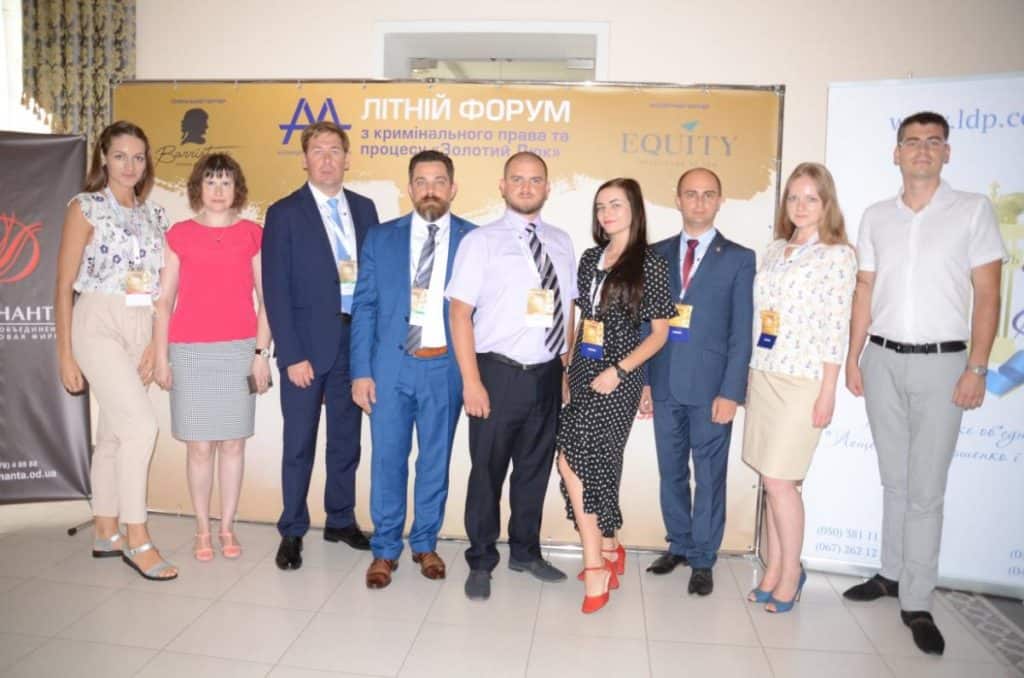
Combining Experience, Theory, and Practice: At a Forum in Odesa, Lawyers Discussed Current Issues in the Application of the Code of Criminal Procedure
On July 6, 2018, the AAU Summer Forum on Criminal Law and Procedure, “Golden Duke,” was held at the National University “Odessa Law Academy,” with “Barristers” Law Firm and “Equity” Law Firm serving as general partners.
The forum served as an engaging platform for discussing amendments to the Code of Criminal Procedure and their practical application, as during the event, nearly 200 participants—attorneys, judges, and scholars—not only discussed practical cases and offered real-world advice on applying the amendments to the Code of Criminal Procedure to attorneys’ work, but also debated the role of the court in criminal proceedings, discussed current topics in criminal law and procedure, and analyzed mistakes, including those made at the legislative level.
Incidentally, it was at this very event that Serhiy Kivalov, President of the National Union of “OYUA,” emphasized in his opening remarks—admitting half-jokingly that he had chosen to hold the forum rather than attend to more pressing matters in parliament. In his speech, S. Kivalov repeatedly stressed the importance of continuously improving the Code of Criminal Procedure. “Six years ago, when the current Code of Criminal Procedure was adopted, we could already see that it was imperfect. At that time, all the criminal law departments at the Odesa Law Academy joined forces with leading experts from the Kharkiv Law Academy, and together we developed specific proposals for amending the CPC. Not many of those amendments were implemented, but the proposals remain. And we continue to promote them. Therefore, today’s forum is a logical continuation of the Odessa Law Academy’s work in this direction. “All of this allows us to systematically discuss the issues and nuances of applying the Code of Criminal Procedure,” noted Serhiy Kivalov. The Academy’s president also emphasized that they particularly welcome those of their faculty members who are continuing or beginning to practice law. “After all, it is precisely under such conditions that the combination of theory and practice is most beneficial, and our students gain a full spectrum of perspectives and insights on a given issue,” the Member of Parliament emphasized.
Expanding on this point, attorney Denis Ponomarenko, a partner at Barristers Law Firm and head of the Odessa branch of the Ukrainian Bar Association, suggested not straying from this important legal symbiosis, and proposed that Serhiy Kivalov sign a memorandum of cooperation between the “Barristers” Law Firm and the National University “Odessa Law Academy,” which was done in a ceremonial atmosphere.
As noted by the signatories of the memorandum, the cooperation aims to expand business relations, improve the quality and effectiveness of professional legal services, develop legal education, and promote the enhancement of students’ professional skills.
The exceptional lineup of speakers, who collectively addressed approximately 20 key issues, attests to how fruitful the exchange of expertise among criminal law specialists proved to be — ranging from a general overview of recent amendments to the Code of Criminal Procedure to the latest trends regarding appeals against rulings not covered by Article 309 of the Code of Criminal Procedure.
The partners of Barristers Law Firm also addressed a wide range of issues. For instance, Denys Ponomarenko discussed the new provisions of the CPC and defense tactics during the pretrial investigation stage of criminal proceedings. In particular, he highlighted an interesting point: if an investigating judge fails to comply with the rules regarding proper audio and video recording of the proceedings, then such an investigative action—for example, the imposition of a preventive measure—may also be deemed invalid.
Meanwhile, the event’s special guest — Ilya Novikov, attorney and partner at Barristers Law Firm — concluded that Chapter 30 of the Code of Criminal Procedure contradicts the Constitution of Ukraine by replacing the jury trial guaranteed by the Constitution with an ineffective model of a lay judges’ court.
According to attorney I. Novikov, who has thoroughly studied the functioning of the jury system for many years, the classic jury system has two distinctive features. First, a verdict is always reached through deliberation; therefore, the jury must not be too large—so that each juror can hear the others (the largest jury currently in Scotland consists of 15 people). If there are fewer than 6, there will not be a sufficient range of opinions, and a meaningful discussion will not take place. The second characteristic is that the jury must have its own distinct area of responsibility and functions. They must be separate from the panel of professional judges. And only a jury of laypeople renders a verdict—guilty or not guilty. Any other model has no right to be called a jury trial.
In turn, Iryna Hlovyuk, head of the Department of Criminal Procedure at the National University “OYU,” associate professor, Ph.D., attorney at Barristers Law Firm, and member of the Supreme Court’s National Qualification Commission—spoke about the legislative prospects for amending the Code of Criminal Procedure in the near future.
Overall, the Forum’s lineup impressed with both its constellation of prominent figures and its professional approach to covering the topics, as nearly every speaker went over their allotted time, yet the audience was understanding of this, since at times one simply did not want to interrupt the speaker.
This was the case, for example, with Alisa Panova, Ph.D. in LawAlisa Panova, an assistant professor in the Department of Criminal Procedure and Operational-Investigative Activities at the Yaroslav Mudryi National Law University, who spoke about specific issues regarding the exclusion of evidence due to a substantial violation of an individual’s rights and freedoms. In particular, the speaker emphasized that Part 2 of Article 87 of the Code of Criminal Procedure contains an open list of acts that the court is required to recognize as substantial violations of human rights, and accordingly, information obtained as a result of such acts is inadmissible as evidence. One such ground is the conduct of procedural actions that require prior court authorization, either without such authorization or in violation of its essential conditions. In the context of this issue, Alisa Panova provided a detailed account of the ECHR’s legal position in its judgment in the case of “Prade v. Germany” dated March 3, 2016. The key finding in this case is that, when determining the admissibility of evidence, courts must consider not only compliance with the procedures for collecting and recording evidence, but also the significance of each specific piece of evidence for establishing the facts of the criminal proceedings, as well as the consequences that would arise if evidence obtained in violation of statutory procedures were admitted.
In general, the following speakers also addressed the forum:
- Denys Bugay, attorney and partner at VB PARTNERS, who shared defense strategies in cases with an international element and ways to prevent extradition;
- Mykola Shumylo, Doctor of Law, professor, corresponding member of the National Academy of Legal Sciences of Ukraine, Honored Worker of Science and Technology of Ukraine, professor in the Department of Justice at Taras Shevchenko National University of Kyiv, spoke on the topic: “The Role and Significance of the Court in the Structure of Criminal Proceedings”;
- Vyacheslav Tulyakov, ad hoc judge of the European Court of Human Rights, Vice Rector for International Relations, Doctor of Law, Professor, Corresponding Member of the National Academy of Legal Sciences of Ukraine, Honored Worker of Science and Technology of Ukraine;
- Nadiya Stefaniv, Justice of the Supreme Court;
- Oleksandra Yanovska, Doctor of Law, Professor, Judge of the Grand Chamber of the Supreme Court;
- Andriy Mazalov, attorney, associate partner at Sheverdin & Partners LLP;
- Yevhen Gilin, attorney, senior partner at Jovanik & Partners LLP;
- Kostyantyn Doroshenko, attorney, partner at Leshchenko, Doroshenko & Partners LLP;
- Olena Kostyuchenko, Ph.D. in Law, Associate Professor, attorney-at-law, partner at Dmytrieva & Partners Law Firm, Chair of the Scientific and Expert Council and member of the Board of the Ukrainian Bar Association, associate professor in the Department of Justice at the Faculty of Law of Taras Shevchenko National University of Kyiv, and many other experts.
At the conclusion of the Forum, letters of appreciation were presented to all participants, organizers, and speakers.
Author: Betrayal.today
Source: