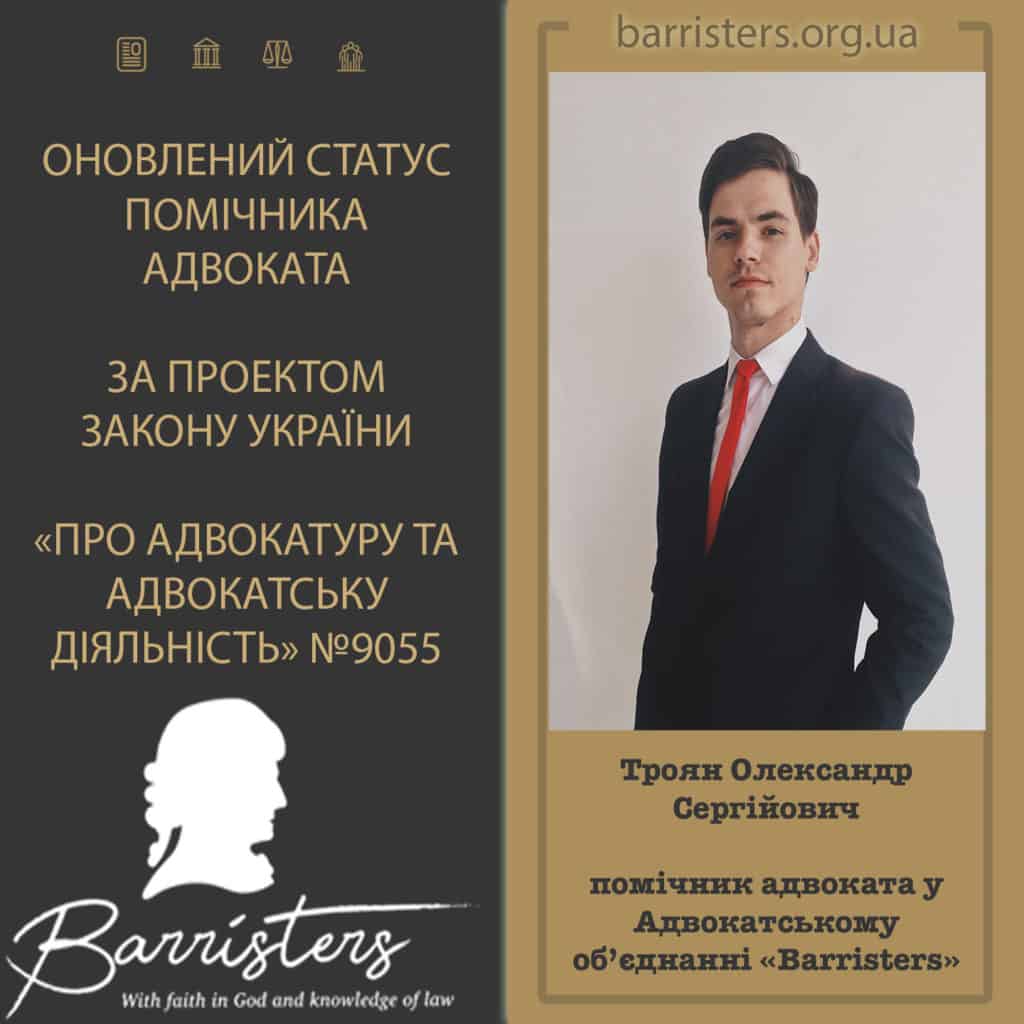
Oleksandr Troyan, Associate at Barristers LLP, on the UPDATED STATUS OF ASSOCIATES UNDER THE DRAFT LAW OF UKRAINE “ON THE BAR AND THE PRACTICE OF LAW” No. 9055
Oleksandr Serhiyovych Troyan
Paralegal at the “Barristers” Law Firm
UPDATED STATUS OF PARALEGALS UNDER DRAFT LAW OF UKRAINE “ON THE BAR AND THE PRACTICE OF LAW” No. 9055
The Draft Law of Ukraine “On the Bar and the Practice of Law” No. 9055 dated September 6, 2018, proposes to update the status of a paralegal. Compared to the currently effective Law of Ukraine “On the Bar and the Practice of Law” dated July 5, 2012, Draft No. 9055 provides a more detailed definition of the status of a lawyer’s assistant, particularly regarding the requirements for obtaining that status, and expands the rights of such assistants.
A positive aspect of Draft Law No. 9055 is that the legislature allows an individual to obtain the status of a lawyer’s assistant after earning a bachelor’s degree in law. Currently, however, the existing Law of Ukraine “On the Bar and the Practice of Law” contradicts the Law of Ukraine “On Higher Education” of 2014 on this issue.
Under the current Law of Ukraine “On the Bar and the Practice of Law” and the Regulations on Legal Assistants, approved by Decision No. 113 of the Bar Council of Ukraine dated September 25, 2015, No. 113, as amended by Resolution No. 109 of July 25, 2018, one of the requirements for obtaining the status of a lawyer’s assistant is the possession of a full higher legal education, that is, a master’s degree; however, as noted above, the Law of Ukraine “On Higher Education” has been in effect since 2014, and it does not contain the term “complete higher education”; instead, it uses the term “higher education,” which specifically includes a bachelor’s degree.
Decision No. 12 of the National Bar Association of Ukraine, dated July 4, 2015, approved a clarification regarding the possibility of entering into an employment contract with a person who has obtained a bachelor’s degree to serve as a paralegal. According to these clarifications, an employment contract with a person as a lawyer’s assistant may be concluded only if such a person has attained the qualification level of “specialist” or “master’s degree” and/or has obtained a specialist or master’s degree. Thus, a person with a bachelor’s degree cannot obtain the status of a paralegal.
Draft Law No. 9055 addresses these shortcomings and introduces the term “higher education,” which includes a bachelor’s degree. This allows a person to obtain the status of a paralegal immediately upon receiving a bachelor’s degree. At the same time, a master’s degree allows a person to obtain the status of a law clerk.
Part 1 of Article 16 of Draft Law No. 9055 stipulates that a law clerk is a legal assistant who holds a higher legal education degree at the master’s level or higher. Given the above, after a person obtains a master’s degree in law, they will hold two statuses simultaneously: they will act as both a legal assistant and a law clerk.
Thus, under Draft Law No. 9055, a person who has graduated from a higher education institution and obtained a bachelor’s degree in law is entitled to obtain the status of a lawyer’s assistant and may already practice in the field of law. At the same time, the individual may continue their studies in a part-time master’s program at a higher education institution to obtain the status of a law clerk.
Another innovation is that Draft Law No. 9055 grants a legal assistant the right to represent a client’s interests in court proceedings alongside a lawyer. In addition, Article 15 of Draft Law No. 9055 establishes the possibility for a legal assistant to participate in investigative (inquiry) proceedings alongside a lawyer.
Currently, the Regulations on Legal Assistants grant legal assistants the right to be present during a lawyer’s court hearings and in investigative (inquiry) proceedings, but only with the client’s written consent.
It is important to highlight the difference in terminology used in the current Regulations on Legal Assistants and Draft Law No. 9055, as this is of great significance for determining the status and rights of legal assistants. While currently a lawyer’s assistant is only entitled to be “present” (as stated in the Regulations on Lawyer’s Assistants), under Draft Law No. 9055, a paralegal has the right to represent (!) the client’s interests alongside the attorney in court proceedings and to participate (!) alongside the attorney in investigative (inquiry) activities. Since the ability to be present and the ability to participate are different concepts that entail different statuses and rights. After all, mere presence involves only observing the actions of the attorney during court proceedings or during investigative (search) activities, whereas the ability to participate grants a person the status of a participant in the court proceedings or investigative (search) activities. This, in turn, implies that the participant has procedural rights and obligations.
In this case, with the establishment of the legal profession’s monopoly on representing individuals in court proceedings, the question arises regarding the status of a lawyer’s assistant, their procedural rights and obligations as a participant in court proceedings, when the legal assistant represents a client alongside a lawyer.
In summary, it can be said that Draft Law No. 9055 has expanded the rights of a lawyer’s assistant and lowered the requirements for obtaining the status of a lawyer’s assistant. At the same time, if Draft Law No. 9055 is adopted, it will be necessary to make substantial changes to procedural legislation regarding the status of a lawyer’s assistant and his or her procedural rights and obligations in court proceedings and during investigative (search) activities.
Author: Oleksandr Troyan
Source: