Press release from Barristers, JSC, regarding the defense’s position on the investigator’s motion to impose a preventive measure on V.L. Chorny
On the night of August 17, 2019, a terrible tragedy occurred—people were killed and injured in a fire.
Just a few hours later, at 10:38 a.m., a Facebook post by the President of Ukraine established the key facts of the incident: “Tokyo Star.” “Last night, we lost eight lives … due to criminal negligence and disregard for basic fire safety standards,” and the person responsible for this tragedy was identified: “Vadym Chornyi, the owner of the so-called hotel, will be held accountable” (https://www.facebook.com/zelenskiy95/posts/2311236525793377). At least during Stalin’s time, the process of publicly identifying the culprit lasted at least a few days.
It is unlikely that the President of Ukraine was acquainted with our Client, or was at the scene of the incident that night or early morning, or had access to pre-trial investigation materials that did not yet exist at that time. An extraordinary meeting of the Odessa Regional State Administration’s Commission on Technogenic and Environmental Safety and Emergency Situations, chaired by the acting head of the administration, S.M. Shatalova, at which the fire was discussed, took place only in the afternoon, after the aforementioned “decree” was issued; the meeting minutes contain numerous inaccuracies, indicating that the commission lacked information regarding the probable causes of the fire, its location, and other details.
It is evident that someone misled the President of Ukraine with the aforementioned Facebook “decree,” which completely disregarded one of the key constitutional principles—the presumption of innocence—and instigated a series of legal violations.
The European Court of Human Rights has repeatedly stated in its judgments—including those against Ukraine (notably, “Shagin v. Ukraine” and “Kryvolapov v. Ukraine”)—that the principle of the presumption of innocence,as enshrined in Article 6(2) of the Convention, is one of the aspects of the right to a fair trial in criminal proceedings, guaranteed by Article 6(1). This principle not only prohibits the court itself from prematurely expressing the view that a person “charged with a criminal offense” is guilty when this has not yet been proven in accordance with the law, but also extends to statements made by other public officials regarding ongoing criminal proceedings that lead the public to believe the suspect is guilty and prejudge the assessment of the facts by the competent judicial authority. It is sufficient—even in the absence of any formal conclusion—to have certain grounds to assume that the official in question considers the accused to be guilty. In this regard, the Court emphasized how important it is for government officials to choose their words carefully when making public statements before the trial of a case brought against an individual and before that individual has been found guilty of a particular crime. Thus, a fundamental distinction must be made between a report that someone is merely suspected of committing a crime and a clear statement, made in the absence of a final verdict, that the person has committed a crime. Whether a statement by a public official violates the principle of the presumption of innocence must be determined in the context of the specific circumstances under which such a statement was made.
In the recent case of “Kryvolapov v. Ukraine,” the European Court of Human Rights reiterated the established principle of its case law that Article 6(2) of the Convention prohibits public officials from declaring a person guilty before a court has handed down a verdict. Officials may inform the public about investigations in criminal cases—for example, by disclosing information regarding the service of notices of suspicion, arrests, and confessions—provided they do so judiciously and with due caution. The choice of words is important. The Court noted that in this case, the statements made in the media by investigators and officials of the Security Service of Ukraine regarding the criminal proceedings against the applicant were far from prudent and circumspect. They constituted an explicit declaration of his guilt, even without specifying the stage of the proceedings: all personal information about the applicant was disclosed to the public, and he was labeled a murderer and a forger in an extremely important criminal case. Such statements by state officials led the public to believe in the applicant’s guilt and influenced the assessment of the facts by the relevant judicial authority. Consequently, the Court concluded that Article 6, paragraph 2, of the Convention had been violated.
However, the police and the prosecutor’s office apparently treated these “conclusions” by the President of Ukraine were evidently treated as an established fact and as a directive for action; and instead of determining the actual circumstances of the fire, a deliberate effort began to fabricate evidence implicating V.L. Chorny in the incident.
It cannot be ruled out that when reporting to the President of Ukraine on the incident and on V.L. Chorny, his active political and civic stance was “taken into account”; therefore, it cannot be ruled out that this case also has a strong political dimension.
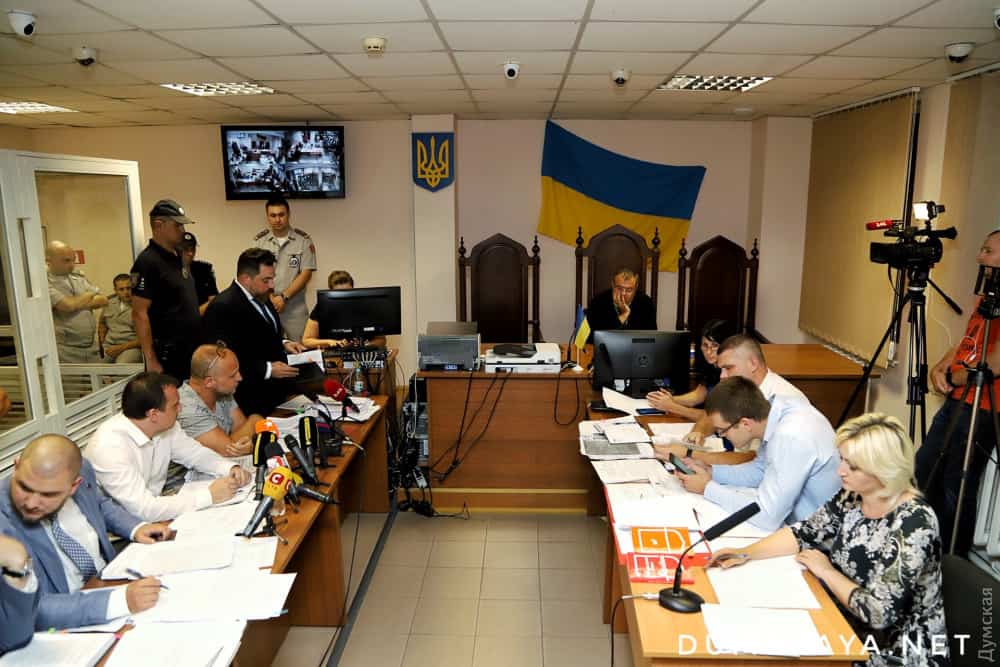
The culmination of the “successes” of the police and the prosecutor’s office in this matter was the investigator’s motion to impose a preventive measure on V.L. Chorny in the form of pretrial detention without the possibility of bail, filed with the Kyiv District Court of Odessa, and its review by the investigating judge.
When the attorneys at Barristers Law Firm received the motion and the accompanying materials from the investigators and prosecutors three hours before the court hearing, they were struck by the abstract nature of the allegations, the risks cited by the prosecution, the evidence provided, and the motion’s failure to comply with the requirements of the Criminal Procedure Code of Ukraine. None of the materials provided by the prosecution (more than 200 pages) contained any reference to V.L. Chorny or his guilt in the fire in question. The materials cited by the investigator in his motion were not provided at all. It was extremely difficult to prepare a defense against the investigator’s motion to impose a preventive measure when it was unclear whether the client was a suspect, what specific criminal offense (based on the factual circumstances) he was accused of, what risks existed, and what evidence the prosecution had regarding these issues (suspicions and risks), was extremely difficult.
The first thing the defense sought to clarify during the court hearing was why this motion was being considered by the Kyiv District Court of Odesa, since the pretrial investigation authority—the Investigative Department of the Main Directorate of the National Police in the Odesa Region—is geographically located in the Primorsky District of our city, at 8A Shevchenko Avenue (this very address was also specified in the order of the deputy chief of the Main Directorate of the National Police in the Odesa Region—the head of the Investigative Department—regarding the conduct of the pre-trial investigation by the investigative team dated August 17, 2019), and according to the law, such motions are to be filed “with the local general court within whose territorial jurisdiction the pretrial investigation body is located.” The investigating judge came to the aid of the prosecution, immediately found on his desk a police order stating that the Main Directorate of the National Police in the Odesa Region was allegedly registered at Akademika Filatova Street in the Kyivskyi District of Odesa, and refused to rule on the issue of determining the jurisdiction over the investigator’s motion. Despite the fact that the website of the Main Directorate of the National Police in the Odesa Region, in the “Contacts” section (https://od.npu.gov.ua/konataktu.html), lists the address as 12 Yevreyska St., Odessa (which is in the Primorsky District of Odessa); by law, the Main Directorate of the National Police is not a pre-trial investigation body; the Criminal Procedure Code of Ukraine does not contain any provision stipulating that the location of a pre-trial investigation body is determined by the location of a law enforcement agency; Furthermore, according to the official website of the Main Directorate of the National Police in the Odesa region, its investigative department is located at “8 Shevchenko Ave.” (https://od.npu.gov.ua/about/struktura/struktura/). The investigators present at the court hearing did not explain exactly where their offices are located on Akademika Filatova Street. An attempt was made to explain this intriguing legal illusion—proposed by the prosecutor’s office and upheld by the investigating judge—on the news website “Dumskaya” (longread: “The Main Directorate of the National Police in the Odesa Region ‘moved’ to the Kyivskyi District to avoid dealing with judges from the Primorsky District” https://dumskaya.net/news/upravlenie-politcii-v-odesskoy-oblasti-pereehalo-102183/). We will not comment on the aforementioned publication; we will merely note that the evidence regarding the alleged registration of the regional police (not the investigative department) in the Kyivskyi District of Odesa was provided to the court by the investigating judge himself…
The defense then attempted to clarify the procedural status of V.L. Chornyi in these criminal proceedings, since a pretrial restraint measure during a preliminary investigation may only be applied to a suspect. Neither the investigator, who was questioned by the investigating judge as a witness, nor the prosecutor was able to provide evidence that V.L. Chornyi was served with a notice of suspicion on August 18, 2019, at the Temporary Detention Center, since V.L. Chornyi’s signature confirming receipt of the notice or a video recording of such service, as required by Article 136 of the Code of Criminal Procedure of Ukraine, was not provided to the court. However, it was established that the investigator, in violation of the requirements of the Code of Criminal Procedure and the Law of Ukraine “On Free Legal Aid,” made two attempts to appoint a public defender for V.L. Chorny, even though V.L. Chorny already had a defense attorney under a contract.
Furthermore, neither the investigator nor the prosecutor provided any explanation regarding the discrepancy between the time of V.L. Chorny’s detention—when the detention report was drawn up (7:13 p.m.)— the actual time of his detention—9:30 a.m. (when V.L. Chornyi arrived at the scene on his own and was restricted in his freedom of movement by police officers, under whose supervision he remained at all times, including during numerous, but fruitless searches of his residence until he was taken in the evening to the Primorsky Police Department in Odesa).
After announcing a “5-minute recess,” which lasted an hour and a half, the investigating judge refused to immediately consider the legality of V.L. Chorny’s detention in the temporary detention facility, refused to determine whether V.L. Chorny had the status of a suspect at the time the motion was considered, yet, before adjourning until the following morning, ordered the investigator to carry out an action not provided for by any law of Ukraine—to re-serve the notice of suspicion, which was immediately done by the witness in this proceeding —by investigator V.S. Blyzniuk in the courtroom under the spotlights of journalists’ video cameras and under the supervision of a group of prosecutors from the Odesa Regional Prosecutor’s Office, who, in theory, are supposed to oversee this investigator’s compliance with the law: E.M. Antoshchuk, T.A. Garkushin, and O.V. Mosko
Attorney D.V. Ponomarenko immediately filed a motion requesting an explanation of the nature of the repeated service of the notice of suspicion, and when the prosecutors and the investigator were unable to provide any answer, a motion was also filed to release V.L. Chorny from custody, since at the time of the so-called “repeated service of the notice of suspicion,” the 24-hour period as provided for in Part 3 of Article 278 of the Criminal Procedure Code of Ukraine, which stipulates that “if a notice of suspicion has not been served on a person within twenty-four hours of the time of detention, such person shall be released immediately.” Once again, the prosecutors failed to provide any response or decision regarding this motion.
On the morning of August 20, 2019, at the start of the court hearing, the attorneys informed the investigating judge that his ruling on the so-called “re-service of the notice of suspicion” to V.L. Chorny was carried out in violation of other requirements of the Criminal Procedure Code of Ukraine—since the investigator, who had been granted witness status in this criminal proceeding, had drafted the motion in violation of the presumption of innocence, and therefore, in accordance with the requirements of Article 77 of the Code of Criminal Procedure of Ukraine, he should have recused himself, or the prosecutors should have initiated proceedings to remove him from the case on that ground. For some reason, the investigating judge left this motion unresolved.
Subsequently, the defense attorneys filed a motion to recuse the group of prosecutors, who failed to ensure even basic objectivity and impartiality in this proceeding, demonstrated a lack of oversight over the investigator’s activities, failed to react in any way to the investigator’s clearly unlawful actions in the courtroom during the “re-service of the notice of suspicion,” and failed to take any measures to remove the investigator—who had been questioned as a witness—from participation in these criminal proceedings. The investigating judge denied the motion to recuse the prosecutors.
Subsequently, Prosecutor Antoshchuk attempted to submit to the court another batch of materials, which the investigating judge refused to accept on the spot by his ruling due to their irrelevance to the case, the poor quality of the copies, and the lack of proper documentation.
The prosecutors’ participation in the investigative judge’s hearing regarding the investigator’s motion to impose a preventive measure was limited to reading aloud the text of the investigator’s motion. No motion to examine any evidence or materials was filed by the prosecutor, nor were any such materials examined by the investigating judge, which indicated the actual absence of such materials.
The defense—the attorneys and V.L. Chornyi himself—in turn drew the investigating judge’s attention to the prosecution’s violation of the presumption of innocence and the principle of personal liberty; the absence of any evidence that V.L. Chornyi has the status of a suspect in this criminal proceeding, and therefore the question of applying a preventive measure to him cannot be raised at all; a series of unlawful actions committed by the prosecution, ranging from the unlawful detention of V.L. Chornyi at 9:30 a.m. on August 17, 2019, to the so-called “repeated service of the notice of suspicion” to the witness in this case and the continued detention of V.L. Chornyi, who, as a detained person, was not served with a notice of suspicion within 24 hours of his detention; the absence of any grounds for suspecting V.L. Chornyi of committing a criminal offense under Part 2 of Article 270 of the Criminal Code of Ukraine, in particular the absence in the investigator’s motion of information indicating that V.L. Chornyi is the owner of thethe facility where the fire occurred, that he is responsible for fire safety at the said facility, or that V.L. Chornyi violated any fire safety requirements established by law. The defense pointed out that the investigator’s motion does not specify any fire safety requirements established by law that were allegedly violated by V.L. Chornyi, which ismandatory when substantiating a suspicion under Part 2 of Article 270 of the Criminal Code of Ukraine, and that there is a lack of any evidence regarding both the suspicion and the potential risks. Furthermore, the documents provided by the prosecution to the investigating judge do not specify the causes of the fire as determined by the pretrial investigation authorities. The defense attorneys also provided the court with evidence indicating that the owner of the facility where the fire occurred is a different person, and that, with regard to the other facility—the one owned by a legal entity headed by V.L. Chornyi—all fire safety requirements established by law were complied with. V.L. Chornyi emphasized his lack of culpability in the incident, noting that he had voluntarily appeared when summoned by the investigator, had no intention of leaving Odesa, took steps to assist the victims, and was ready to assist the investigation in fully, comprehensively, and objectively establishing all the circumstances.
All of this indicated that V.L. Chornyi’s arrest and his detention for three days were unfounded, and that the decision to issue a notice of suspicion against V.L. Chornyi and to file a motion with the court requesting the application of a preventive measure were premature.
All of this indicated that both the investigator and the prosecutor—without examining the case materials, adhering to legal procedure, exercising common sense, or providing proper justification for their procedural decisions—had attempted to carry out someone’s instructions regarding the immediate isolation of V.L. Chorny and his persecution. Evidently, certain individuals have not forgotten V.L. Chorny’s active civic stance, his incisive journalistic articles, and his support for civil society activists and journalists who oppose the authorities.
Nevertheless, after a nearly two-hour deliberation in the consultation room, the investigating judge ruled to impose a pretrial detention measure on V.L. Chorny without the possibility of bail.
Immediately after receiving the incomplete ruling from the investigating judge—which consisted only of the operative part—the defense prepared an appeal against the ruling and filed it with the Odesa Court of Appeals.
Obvious and gross violations of human rights, especially when they occur with the judge’s connivance, cannot go unchallenged without an immediate and forceful response from attorneys.
Note: V.L. Chorny’s defense is being handled by Denis Ponomarenko and Yuriy Zhovtan, partners at Barristers Law Firm, as well as Mykola Pashkovsky, an attorney and scientific advisor at Barristers Law Firm.


Author: BARRISTERS
Source: