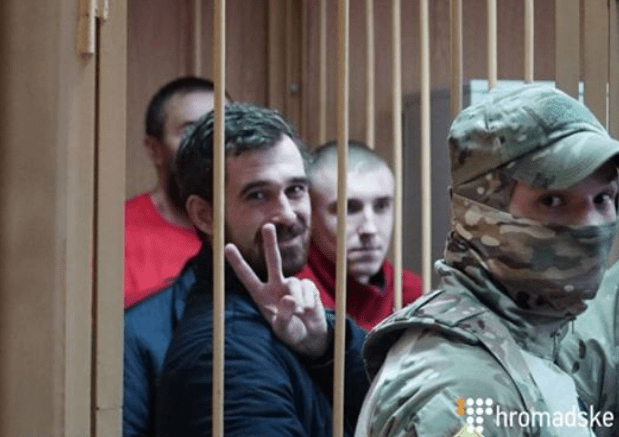
Ilya Novikov, a partner at BARRISTERS, J.S.C., discusses the Lefortovo Court’s assembly-line-style trial of 24 Ukrainian sailors who were detained on November 25 during the “incident in the Kerch Strait.”
- Mokryak, please stand up. State your full name
to the court
- Roman Nikolaevich
Mokryak
- Date of birth
- July 25, 1986
- Place of birth… Why are you silent? State your place of birth
.
- Article 17 of the Geneva Convention stipulates that a prisoner of war has the right not to disclose any information about himself other than his name, rank, date of birth, and personal identification number
.
- What is your registered address?
- I will not answer
you
- Education?
- I will not answer
- All right, it’s clear you won’t. Semidotsky, stand up. State your full name to the court…
Today, the Lefortovo Court continued, in an assembly-line fashion, the detention of 24 Ukrainian sailors captured on November 25 during the “incident in the Kerch Strait.” They were divided into six groups of four (the cage in the courtroom cannot hold more than four people), and those groups were assigned to three different judges. The first hearing was scheduled to begin at 9:30 a.m., and the second at noon, with plans to wrap up the case before lunch. As I write this, it is 9:00 p.m., and the last hearing has still not concluded. This alone gives an idea of what a trial involving 24 people would turn into, should it ever come to that.
The scene with Roman Mokryak’s questioning took place at the beginning of the session, when the public had not yet been removed from the courtroom. Following Roman’s example, all the others testified in the same manner during all the sessions. This was our way of clearly stating the defense’s position. Today’s hearing was the Ukrainian sailors’ first public appearance since their arrest, and it was known in advance that most of it would take place behind closed doors, so we had to make the most of the time we had. Among the audience were diplomats from European embassies; they managed to hear only two things: the sailors are demanding to be recognized as prisoners of war, not criminals, and that the prosecution is asking the court to hear the case without the public present, even though there are no classified documents in the case file. Immediately after this statement, the request was granted, and the public was ordered to leave. First, a motion was filed to transfer jurisdiction from the Lefortovo Court to the Moscow Garrison Court: the Geneva Convention requires that cases involving prisoners of war be heard exclusively by military courts. Three judges, in three separate sessions, simultaneously withdrew to deliberate for an hour and a half, then simultaneously returned and announced identical denials. Then, on the same grounds, we objected to the prosecution’s motion to extend the detention: prisoners of war may be held in specially equipped camps, but not under prison conditions. In the camp, they have the right to wear their military uniforms and insignia and not to be separated from one another. In the detention center, they were forced to change into prison uniforms and were all placed in separate cells.
The main position of the Russian side—whether it be the investigators, the prosecutor’s office, or the judges—is that “if there is no war, then there are no prisoners of war; this is an ordinary criminal case.” In fact, the 1949 Geneva Convention relative to the Treatment of Prisoners of War explicitly states that it “shall apply in the event of a declared war or any other armed conflict.”
I even cited for the court the highest achievement of border-related scholarship—the *Border Dictionary*, published by the FSB in 2002 (since it was border guards who were participating on the Russian side). “An armed conflict is … various military incidents, military operations, and other armed clashes of a minor scale (low intensity) involving regular forces… According to the dictionary, the state(s) do not enter a special state defined as war…”—the dictionary authoritatively explains to us. After that, we reread from the case file the report by Captain Second Class Shipitsin, commander of the “Izumrud”: “At 8:54 p.m. on November 25, 2018, permission to open fire to neutralize the target was received from Admiral G.M. Medvedev, head of the FSB’s Department of Counter-Terrorism. At 8:55 p.m. on November 25, 2018, we opened fire to destroy the target.”
In court, these three quotes—from the convention, the dictionary, and Captain Shipitsyn—did not fit together at all. Yes, they fired to destroy on the admiral’s orders, and at Ukrainian ships and sailors, but what does an armed conflict and the Geneva Convention have to do with this? Absolutely nothing.
9:20 p.m.—they’re still listening to the last four. *The Longest Day* and *A Bridge Too Far*.
Author: BARRISTERS
Source: