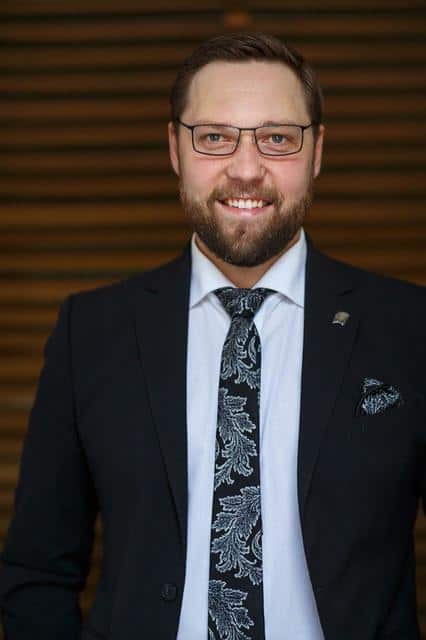
Oleksiy Shevchuk, Partner at BARRISTERS, JSC, on the political significance of establishing a full-fledged jury trial system in Ukraine
The presidential campaign is slowly gaining momentum in Ukraine. With very few exceptions, virtually all the candidates are competing to see who is more European and more pro-Western. And in this regard, I have one proposal for both the current and future presidents of Ukraine. The only thing cooler than visa-free travel—which we did manage to secure (a victory)—and the construction of the bridge to Troieshchyna (a betrayal) could be… the establishment of a full-fledged jury trial system in Ukraine.
The jury system is the cornerstone of American justice, and I don’t think I need to convince you that the U.S. is the model for the legal system of a modern democratic state. One can criticize the American electoral system or its foreign policy maneuvers, and even the actions of its security forces, which are under constant scrutiny by the international human rights community (see Guantanamo), but no one would dispute that the American judicial system serves as a model for the entire world.
So, there is no democratic court without a jury trial. At least in the U.S., they are convinced that this is exactly the case. Moreover, serving on a jury is the duty of every American citizen. By way of comparison: the duty of every Soviet and post-Soviet citizen was to serve in the army. Here alone, we can see a striking difference between what the Soviet Union wanted from its citizens (more cannon fodder!) and what the United States wanted (more responsible citizens!), but that’s not the point right now.
The Constitution of Ukraine (Articles 124, 127, etc.) provides for a jury trial. However, these constitutional provisions have not been further developed in subsequent legislation. What we currently refer to as a jury trial (2 judges + 3 lay jurors sitting together—Art. 31, Part 3, and Art. 383, Part 3 of the Code of Criminal Procedure of Ukraine) is, in fact, a model based on the German Schwurgericht. Why is this not a jury trial? First, there is no diversity of opinion. It is generally accepted that a jury panel should consist of at least 6 people (the position of the U.S. Supreme Court); the classic model is 12 jurors, and an unusual one is 15 jurors (Scotland). Second, jurors cannot serve alongside judges in the same panel, neither organizationally (discussing the case in the same room) nor functionally (a professional judge must address procedural issues, while the jury must address questions of fact and guilt). If these two conditions are not met—the number of jurors and their independence from professional judges—then there can be no talk of a jury trial. Only of some sort of surrogate model.
The specific challenges in Ukraine are also clear. Few people want to serve on a jury when other trials drag on for years. But this is a problem inherent to the jury trial as a model of justice; it stems from the criminal procedure code and the efficiency of the judicial system.
There are currently two bills before the Verkhovna Rada of Ukraine that provide for the reform of the Ukrainian jury system. I will briefly discuss them.
The bill introduced by Prime Minister Volodymyr Groysman provides that not only those facing life imprisonment but also anyone facing a potential sentence of 8 years or more in prison will be able to request a jury trial. But what is most interesting is that the Cabinet’s document makes a tentative attempt to distinguish between the powers of jurors and professional judges; however, this distinction is not clearly defined, and, most importantly, it does not provide for separate deliberations by jurors and judges.
In contrast to the government’s bill, the bill proposed by People’s Deputy Serhiy Vlasenko (“Batkivshchyna”) lowers the sentencing threshold required for a jury trial to 10 years, while providing for the creation of a full-fledged jury panel of 12 members.
Thus, both bills attempt to address the fundamental issues raised above, but they are still quite rough around the edges, which is why they were criticized by the Verkhovna Rada’s Main Scientific and Expert Directorate and sent back for revision.
Incidentally, Vlasenko’s bill stipulates that regular jurors will receive the salary of a professional judge, while alternate jurors will receive a salary equal to their income at their last place of employment, which goes a long way toward addressing the low level of public interest in serving on juries. Furthermore, this bill stipulates that when jurors are considering high-profile cases, their communication devices may be confiscated, and they themselves may be placed in a special secure location to prevent any pressure from being exerted on them.
These are important details; however, the Main Scientific and Expert Directorate of the Verkhovna Rada rightly notes that, amid the ongoing judicial reform, courts are already facing a staffing shortage, judges are overburdened, and in this situation, protracted trials involving jurors are unlikely to facilitate the adjudication of cases within a reasonable timeframe. It is difficult to argue with this.
But the reform of the jury system must take place as part of the broader judicial reform, not be discussed on the sidelines.
But the main argument of those opposed to the full-scale implementation of a jury system in Ukraine lies not in the legal sphere at all. I would even call it a thoroughly anti-Ukrainian argument—and it goes like this: “Our people aren’t ready.” Well, that is to say, in Russia (which, as we know, is not Ukraine), people have been ready for over two decades (the jury system was introduced in the Russian Federation in 1994 and, by the way, it’s practically the only judicial institution that actually works in Russia—there’s even a book by Russian lawyers titled *The Jury System: The Last Chance for Themis*, whose title speaks for itself). Moreover, since the summer of 2018, the scope of criminal cases handled by jury trials in Russia has expanded even further—juries now sit in district courts as well! But in Ukraine, as you can see, people aren’t ready. Meanwhile, Russia is confidently looking toward Asia and China and expanding its jury system, while Ukraine is moving toward Europe and saying that “our people aren’t ready.” What a paradox and absurdity!
At the same time, the historical roots of the Ukrainian jury system are even deeper than those of the Russian one. Jury courts in Kharkiv, Odesa, and Kyiv operated within the framework of the Russian imperial jury system, while in western Ukrainian territories, Austro-Hungarian, Romanian, and Polish jury courts—and even those of the West Ukrainian People’s Republic (ZUNR)—had a chance to function.
Yes, judicial reform to establish a full-fledged jury system is no easy task; it will require considerable effort and resources. But at one time, military reform and the creation of a modern, combat-ready army also seemed like an insurmountable task. But life compelled us to act, and it turned out that nothing is impossible! And so life compels us once again: the path of European integration chosen by the country inevitably requires us to establish a full-fledged jury system in Ukraine based on the best Western models. Establishing such a jury system would be a tremendous achievement for any president of Ukraine—old or new—and for any Verkhovna Rada—old or new—and this political decision would best cement Ukraine’s course toward European models of life.
Author: Oleksiy Shevchuk
Source: