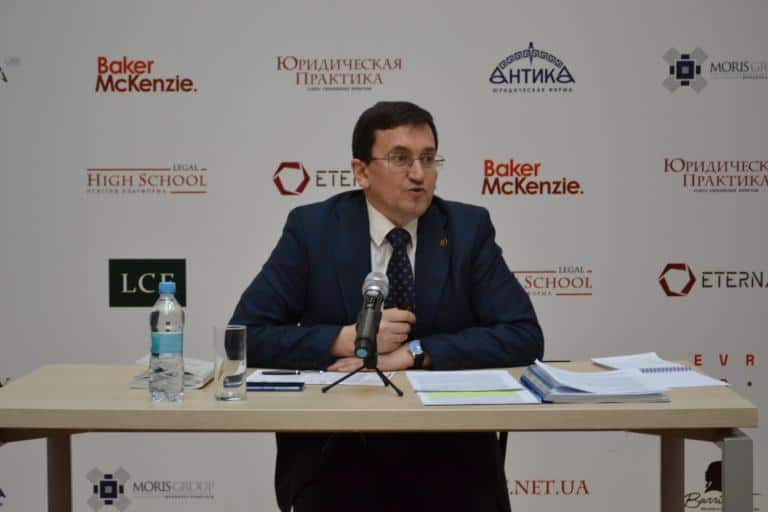
"Violations of the Right to Defense in the Early Stages of Criminal Proceedings" is the topic of a lecture by Mykola Pashkovsky, Ph.D. in Law,, Associate Professor Mykola Pashkovsky
The practice of Ukrainian courts and the European Court of Human Rights (ECHR) in cases involving violations of the right to defense during the initial stages of criminal proceedings was the subject of a lecture by Mykola Pashkovsky, a legal advisor at Barristers, a member of the Scientific Advisory Council at the Supreme Court, Ph.D. in Law, and associate professor.

At the beginning of the lecture, Mykola Pashkovsky clarified that both the field of criminalistics and national courts, as well as the European Court of Human Rights (ECHR), distinguish the initial stage of the pretrial investigation (initial stage), characterized by the particularly intensive nature of investigative and other procedural actions, which are often associated with restrictions. the rights and legitimate interests of citizens and aimed at investigating criminal offenses while the trail is still “hot,” as well as collecting evidence and preventing its loss in criminal proceedings.
Given that the right to defense in a specific criminal proceeding arises from the moment the prosecution initiates criminal proceedings, it is important to recognize that there are both formalized (through arrest or notification of suspicion) and informal moments marking the commencement of criminal prosecution and, accordingly, the right to defense. Professor I.V. Glov’yuk’s works on the theory of criminal procedure are devoted to this issue. Case law, including the practice of the European Court of Human Rights (ECHR), indicates that such informal (de facto) criminal prosecution (through unlawful searches, inspections, examinations, police interrogation) is not only present in procedural activities but also grossly violates the right to defense, the right to liberty, and, as a rule, leads to the inadmissibility of the evidence gathered.
Given the limitations of Ukraine’s Code of Criminal Procedure regarding the identification of de facto criminal prosecution, Mykola Pashkovsky urged Legal High School students to follow the practice of the ECHR, particularly regarding the ECHR’s autonomous interpretation of the concept of “charge” and the various tests used to assess whether legal situations comply with standards developed in its case law. The ECHR (for example, the Engel test, the test developed in the case of “Salduz and Others v. Turkey,” etc.).
The lecturer then focused on the problem of the defense’s effective response to such factual (informal) criminal prosecutions. He emphasized that the existing practice of the Cassation Criminal Court within the Supreme Court indicates that, as a rule, courts deem such evidence inadmissible.
The appropriate (correct and timely) application of ECHR case law, in the speaker’s view, is necessary both to address gaps in Ukraine’s Code of Criminal Procedure and to ensure the consistency of judicial practice.

Author: Legal High School
Source: