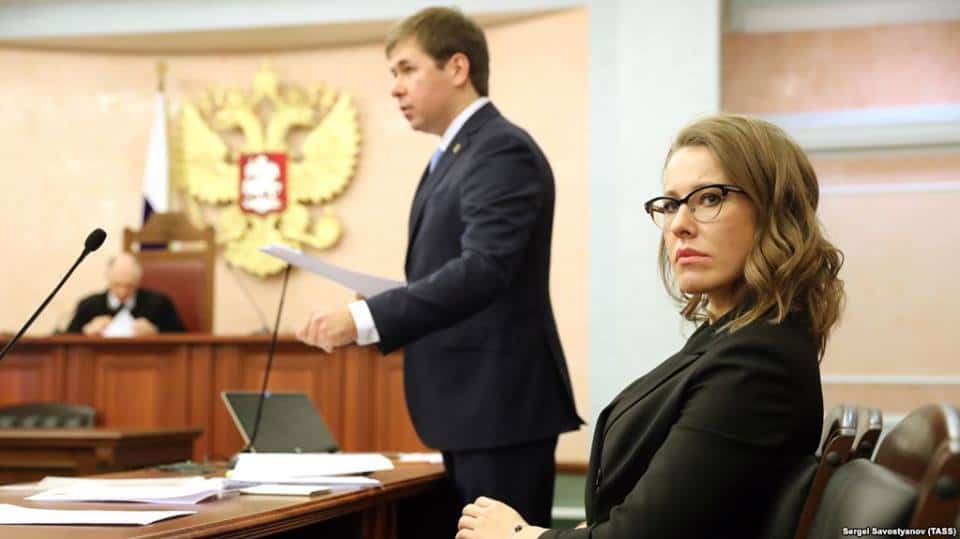
The Supreme Court issued the reasoning section of its ruling on the appeal regarding Ksenia Sobchak’s administrative complaint to the Central Election Commission seeking to revoke Putin’s registration as a presidential candidate
The case is not yet over, and it’s already clear that it’s turning out to be an interesting one. For now, a brief word on what we wanted to achieve and what we’ve managed to accomplish. After two levels of review, I was hoping to receive clear answers from the Supreme Court to three questions. We received them, they’re quite clear, and that’s one positive development.
First, when the Supreme Court agrees with the Central Election Commission that the hiatus following Putin’s second presidential term will reset the count—is it offering us its own original interpretation of the Constitution, or does it believe the Constitutional Court has already ruled on this matter? This is important because the Constitutional Court’s ruling on Part 3 of Article 81 of the Constitution (“the same person may not hold the office of President of the Russian Federation for more than two consecutive terms”), which everyone cites in their favor, was adopted in 1998, in a completely different situation—when Yeltsin’s final four-year term was coming to an end, not Putin’s penultimate six-year term. This distinction may prove significant in the future. In the first ruling on Sobchak’s lawsuit dated February 16, there was no direct answer to this question, but the appeal was quite clear—the Supreme Court is not offering a new interpretation. They believe that the issue was resolved in principle by the Constitutional Court twenty years ago. In other words, the CEC’s position has not two points of support in the Supreme Court’s rulings, but at most one—and even that is not entirely solid in the long term. Very well, let’s make a note of that.
Second, it was important to see how the Supreme Court would finally explain its refusal to delve into Medvedev’s nominal role in 2008–2012, and what constitutional consequences the president’s apparent nominal withdrawal from supreme power—while retaining shadow influence—might entail (the “Simeon Bekbulatovich criterion”). It was clear that the court, as it was called, would not want to touch the case even with a very long stick. The appellate court took the same approach as the lower court—pointing out that the statements by Medvedev and Putin, in which they explicitly acknowledge that the transfer of the presidency from Putin to Medvedev and back was surrounded by secret agreements, are irrelevant. The Supreme Court may have said a little more than it intended. If they had simply cited the fact that the notarial verification protocols submitted by the plaintiff—RIA Novosti and Kremlin.ru—were, for some reason, officially inadmissible as evidence, that would have left the CEC’s opponents with fewer points of support in their subsequent arguments. The Constitutional Court has already addressed the relevance of the President’s public statements to Article 81 of the Constitution. In the same ruling of November 5, 1998, Yeltsin’s statement that he did not intend to run for another term is clearly cited as one of the elements in the court’s legal reasoning. A word, in general—especially a president’s word—is not a sparrow (I prefer the Polish version of this proverb: “A word is not smoke”). This creates legal consequences even against the speaker’s wishes. So far, we have noted that in 2018, when asked about the “Bekbulatovich criteria,” the Russian Supreme Court refused to discuss them—not on the grounds of weak evidence, but on the grounds that they were irrelevant. This is also an important milestone for looking ahead to the future.
Third, the question of why Putin was not involved in the discussion of his possible removal from the race and did not even announce the meeting. Generally speaking, the appellate panel had the opportunity to acknowledge that the trial court had erred in this regard, but at the same time not to overturn the decision, since Putin’s rights had not been violated. It did not acknowledge that the court was wrong, as might have been expected, given that when discussing the revocation of a candidate’s registration, the candidate himself is not particularly interested in the matter. This has little impact on anything, but in its own way underscores the position of both branches of government. “You came to pray for rain, but you came without true faith—none of you brought an umbrella.” If the court begins to discuss Putin’s candidacy without Putin present, does that imply that it already knows what the decision will be?
There are also a fourth and fifth point. As a bonus, on top of that, we’ve received two more important points from the Supreme Court. One of them is that it’s not enough for a president serving a second consecutive term to simply resign shortly before the election, handing over the office for a couple of months. It is necessary for the successor to have actually been elected (“The right to hold office again if, after the expiration of these two terms of office as President of the Russian Federation, there was an interval during which another citizen of the Russian Federation was elected to this office and exercised the powers of the President of the Russian Federation”). And in 2007, as some may recall, we discussed such options for Putin. And God knows whether this idea will resurface in 2021. Second, the Supreme Court recognizes paragraph 5 of Article 3 of the Law “On the Election of the President of the Russian Federation” as the sole provision to which it refers, and which therefore boils down to Part 3 of Article 81 of the Constitution. This, in principle, opens the door to the Constitutional Court. The real open question is whether it is tactically advisable to do so now, in 2018, given the court’s current composition.


Author: Partner at Barristers, LLC: Ilya Novikov
Source: