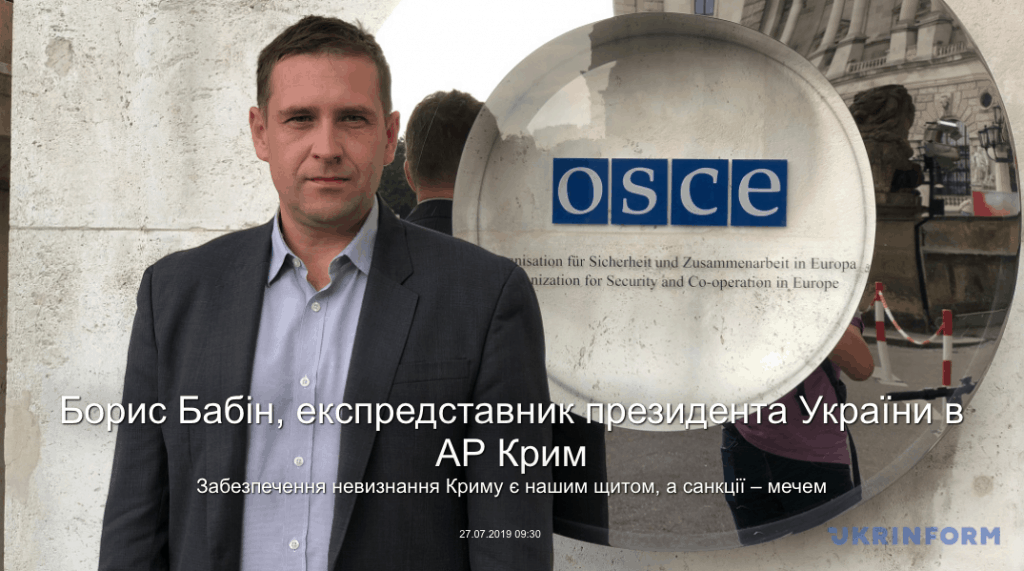
“Ensuring that Crimea is not recognized is our shield, and sanctions are our sword,” said Boris Babin, legal advisor at BARRISTERS, LLC
Boris Babin is an excellent expert for journalists to consult on topics related to Crimea, the human rights situation on the peninsula, ways to engage international mechanisms to improve it, as well as discussions on the de-occupation of Crimea in general. From August 2017 to December 2018, he served as the President of Ukraine’s representative in the Autonomous Republic of Crimea; he is an expert for a number of Ukrainian and international organizations— the Ukrainian Independent Seafarers’ Union, the Crimean Tatar Resource Center, the Foundation for Research and Support of the Indigenous Peoples of Crimea, the Council of Europe, and Minority Rights Group International—as well as an ad hoc expert for the OSCE.
Boris Babin is convinced that Ukraine—its government agencies, representatives of civil society, and the expert community—must actively convey its position at any events organized by any international organization that are directly or indirectly related to human rights or other issues pertaining to Russian aggression. “If we remain silent, we lose,” he emphasizes.
Ensuring, to the greatest extent possible, that the attempt to annex Crimea is not recognized at all levels is one of the two main pillars of the strategy for the de-occupation of Crimea. If we show any weakness here, then in 30–40 years, due to Russia’s influence, the world may recognize this attempted annexation, Boris Babin believes. And if the above constitutes a kind of “defense” for Ukraine, then its “offense” is ensuring the continuation of current sanctions against Russia and their strengthening.
Boris Babin spoke to a Ukrinform correspondent in Vienna about this, as well as the prospects for an international human rights mission in Crimea and access for the OSCE SMM, ways to enhance the effectiveness of the dialogue between the Ukrainian and Russian ombudsmen, the release of sailors and other Ukrainian hostages, “Scythian gold,” the “purchased” PACE, and what Ukraine should do next—Boris Babin spoke with Ukrinform’s correspondent in Vienna.
THERE ARE NO MECHANISMS IN CRIMEA TO PROTECT HUMAN RIGHTS ON THE GROUND
- Boris Volodymyrovych, you had a packed schedule—first, participation in the session of the UN Expert Mechanism on the Rights of Indigenous Peoples in Geneva, then a presentation as an expert at the OSCE meeting in Vienna dedicated to the human dimension. What are your impressions of these events—how important are they, and is the “Ukrainian case” sufficiently represented in the international discourse, given the widespread repression in the Russian-occupied territories of Ukraine?
If we remain silent, we lose. We must speak out and convey our position—and do so competently and with evidence
- I have been working in the field of human and peoples’ rights protection for quite some time, both with UN agencies and with OSCE structures. It is clear that these are tools with certain limitations. However, if we know how to use them correctly—including the expert community, society, and the Ukrainian state—we will see results. If, on the other hand, we ignore certain measures or treat them merely as a formality, even very powerful tools will be of no use. Conversely, sometimes negotiation processes—even in fairly limited settings—can yield tangible results.
That is precisely why civil society and the expert community in Ukraine—especially in the context of aggression and the occupation of part of the country’s territory—have no right to distance themselves from any initiatives by any international organization that are directly or indirectly related to human rights, the rights of peoples, or other issues pertaining to Russian aggression. If we remain silent, we lose. We must speak out and convey our position—and even better, do so competently and with evidence.
As for the UN Expert Mechanism on the Rights of Indigenous Peoples, its sessions are very important, since that is precisely where the fate of the Crimean Tatars and other indigenous peoples should be discussed, particularly in the context of the occupation.
This year, within the framework of the Mechanism—the UN Human Rights Council and other UN bodies—two key reports are to be submitted: one on displacement and borders that divide indigenous peoples, and another on compensation for and recognition of indigenous peoples. It is clear that both reports directly concern the Crimean Tatars under occupation. Certain civil society institutions had previously submitted relevant proposals and comments to the Expert Mechanism; however, unfortunately, these were not taken into account. To some extent, someone failed to follow through—whether at the state level or among the experts.
During the meeting in Geneva, the efforts of Ukraine’s representatives—from the expert community and indigenous peoples—were aimed at demonstrating the need to reflect the plight of Crimea’s indigenous population, primarily the Crimean Tatars, in UN documents that, at the General Assembly level, condemn Russian aggression and the occupation of Crimea. In Geneva, I stated directly: “Ladies and gentlemen, if we have 20,000 internally displaced Crimean Tatars, members of an indigenous people, how can the Expert Mechanism on the Rights of Indigenous Peoples turn a blind eye to this?”
There will be other studies to come. For example, next year the UN will examine the land rights of indigenous peoples, followed by their right to self-determination. And if we continue to remain silent, the words “Ukraine,” “Crimea,” and “Crimean Tatars” will once again be absent from these reports.
In Crimea, there is no justice, no law enforcement agencies—only the punitive system of the occupying authorities.
As for the OSCE, it is more of a regional mechanism, a platform for dialogue in both the post-Soviet and pan-European spheres. The OSCE also devotes significant attention to human rights as part of the so-called “third basket.” That is why the OSCE holds annual human rights meetings: one major one in Warsaw in the fall, and smaller, thematic ones in Vienna. The main topic of the two-day meeting, in which I participated, was interstate dialogue on the protection of human rights. A separate session was devoted to cooperation among ombudsmen on human rights issues, which is of particular importance to us in the context of the Ukrainian-Russian conflict. It is a pity that no representative from the Office of the Ukrainian Ombudsman was present…
Who can protect the rights of the population in the occupied territories—for example, the people of Crimea? Currently, there are no mechanisms in place on the peninsula that would allow for the protection of human rights on the ground. There is no justice there, no law enforcement agencies—only the punitive system of the occupying authorities. Russia also does not allow international organizations to operate in Crimea—neither the UN, nor the OSCE, nor the Council of Europe, nor anyone else. In my opinion, it is precisely at the ombudsman level that we can try to make some progress in this area.
INTERNATIONAL HUMAN RIGHTS DEFENDERS MUST BE IN CRIMEA ON TERMS OTHER THAN THOSE SET BY THE OCCUPIERS
- According to some experts, a permanent human rights mission established specifically on the peninsula under the auspices of the largest intergovernmental organizations—the UN, the OSCE, and the Council of Europe—could help alleviate the human rights situation in Crimea. What is your view on this idea and the feasibility of its implementation?
- Overall, it’s a good initiative. But I’m skeptical about its prospects, since we’ve already seen disheartening precedents.
Yes, in 2015, the OSCE High Commissioner on National Minorities visited occupied Crimea and issued a report based on the results of his trip. It’s not that the report was pro-Russian (it was more or less objective), but it’s important to understand that, in terms of logistics and communication, he couldn’t act freely during his visit: he saw what the occupying authorities wanted him to see and spoke with those whom the occupying authorities introduced to him.
Another example is the Red Cross. In 2015, Ukraine gave a sort of semi-formal consent for the ICRC to be represented in Crimea—but not through its Ukrainian office, rather through its Russian office. This was a necessary humanitarian approach, although, of course, not a very good one from a political standpoint.
And this Red Cross entered the peninsula on the occupiers’ terms. For example, it was allowed to provide humanitarian aid exclusively to people from eastern Ukraine who had arrived in Crimea. And Russia turned this into a propaganda stunt: “See, the ICRC is helping ‘refugees’ from Ukraine in Crimea, where there’s no shooting.” In other words, an international organization, while fulfilling its mandate to a certain extent, was essentially playing into Russia’s hands. And when Crimeans themselves—victims of repression—began turning to this office, they were told that the ICRC had no right to help them, because Russia had granted the right to assistance only to displaced persons from Donbas.
Excuse me, but when the occupiers let people in under such conditions, who benefits from this? The population—no. Ukraine—no. The supremacy of international law—no. Then why do we need this?
But we must explore every possible option—it is our duty to protect our citizens by any means necessary within the bounds of international law.
A THIRD PARTY MUST BE INVOLVED IN THE DIALOGUE BETWEEN THE UKRAINIAN AND RUSSIAN OMBUDSMEN
- You mentioned cooperation between the ombudsmen. How can this cooperation be made more effective in protecting human rights in Crimea and securing the release of Ukrainians detained in Russia?
- The Russian Federation has appointed its own fake ombudsmen in Crimea. There is the so-called “Ombudsman of the Republic of Crimea,” and there is the so-called “Ombudsman of the City of Sevastopol.” The “Sevastopol” ombudsman is, as they say, “a figurehead”—he just sits there and does nothing. The “Crimean” ombudsman, on the other hand, not only does nothing to protect human rights but also sometimes allows himself to make political statements about “damned Ukraine” and the “Kyiv junta.” In fact, this “Crimean ombudsman” is nothing more than a tool of Kremlin propaganda. It goes without saying that no one involved in political matters or issues related to the Ukrainian-Russian conflict would ever turn to him.
We need to look for other ways. The Ukrainian Ombudsman appointed a representative for Crimea some time ago, but he is based in Kherson and will not travel to Crimea because the occupiers will not let him in. In other words, there can be no dialogue at the grassroots level, and bilateral dialogue between the ombudsmen, unfortunately, faces certain challenges. On the one hand, our ombudsman is an independent political and administrative entity (sometimes completely autonomous on political issues, especially during election campaigns). On the other hand, there is the Russian Federation’s ombudsman, who is part of the Russian Federation’s administrative system, and this individual was formerly a general in the Russian police (no comment needed here, as they say).
Of course, when the Russian Federation authorizes this person to carry out a specific negotiating mandate, we must make use of that opportunity. But a different situation arises when, within the framework of such negotiations, the aggressor state humiliates the Ukrainian ombudsman: she flies to Moscow, and no one speaks to her; she arrives at some Russian penal colony, and no one lets her in. In my opinion, if Russia is wiping its dirty boots on our official, perhaps she should travel there not alone, but with some European ombudsman colleagues? So that the Russians at least wash those boots first?
That is precisely why, during the OSCE meeting in Vienna, I said: if this dialogue between the Ukrainian and Russian ombudsmen is ineffective, then perhaps it would be worth involving ombudsmen from third countries—for example, from Germany or France, or even from some post-Soviet state. Then such a dialogue would no longer be so politicized. This proposal was quite well received not only by OSCE experts and staff but also by representatives of ombudsman institutions from other countries. Perhaps there will be some formal or informal proposals from them in the future; we’ll see.
I’d also like to cite one telling example: in 2018, after Ukraine detained the fishing vessel “Nord,” Russia began detaining Ukrainian fishermen in the Black Sea; several crews of small vessels were seized. The Russians held them in occupied Crimea without any formal charges, simply at a military base, as hostages. Under these circumstances, among other things, appeals were made to the ombudsmen. And the Russian ombudsman officially demanded an exchange from Ukraine, referring to these individuals as hostages. In other words, if the Russian ombudsman allows himself (of course, we understand that this was not his own initiative) to put forward proposals regarding the exchange of individuals who are hostages of the Russian authorities—then this characterizes both this person and the system itself very clearly. Anyone interested should read the definition of the international crime of “terrorism”…
It is obvious that under such circumstances, a bilateral format of cooperation is impossible. If there is a third party involved, then at least such cynical proposals will not be made, and Russia will at least somewhat restrain itself.
Author: Vasyl Korotkyi, Vienna
Source: