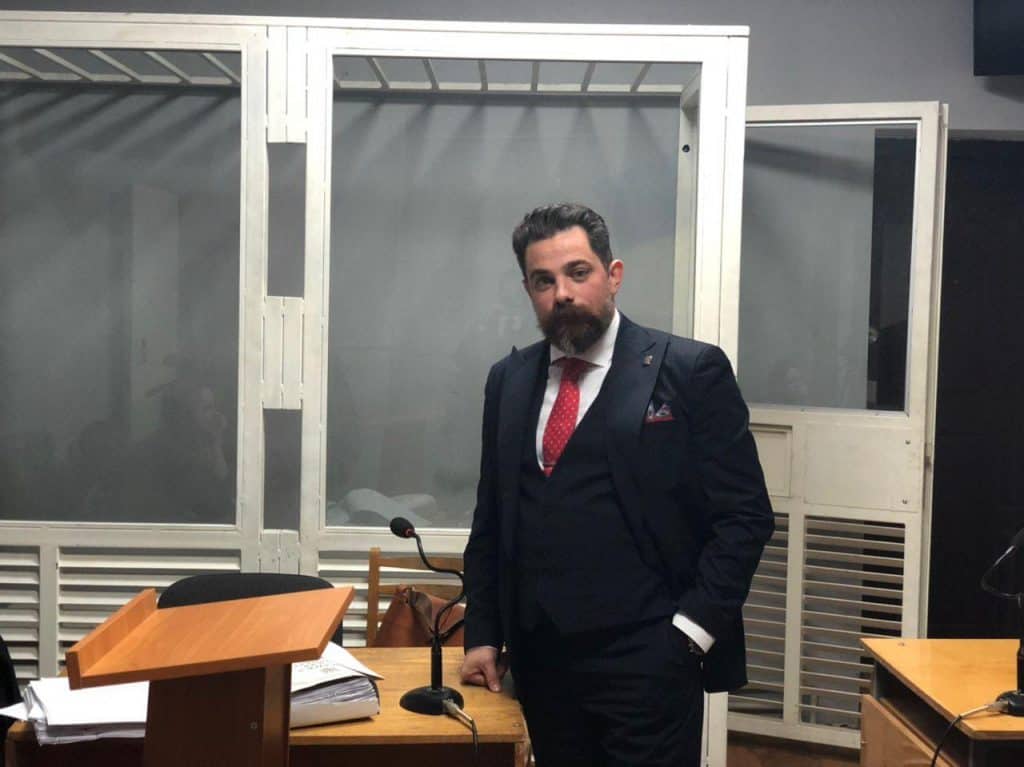
Sunday court hearing for Denis Ponomarenko, a partner and attorney at the "Barristers" law firm
Sunday court hearings are so strange...
Judicial and legal reform has been underway in Ukraine for twenty-six years now (if counted from the well-known resolution of the Verkhovna Rada of Ukraine dated April 28, 1992, No. 2296-XII), but the effectiveness of the justice system leaves much to be desired.
This post discusses one example of “Sunday justice.”
Denis Ponomarenko, a partner and attorney at the “Barristers” Law Firm, is providing pro bono defense in one of the criminal cases currently pending before the Bilhorod-Dnistrovskyi City and District Court of Odesa Oblast — a murder case in which one person (who was young at the start of the proceedings), O.M. Kornienko, is being unjustifiably prosecuted.
The case began back in 2008, and O.M. Kornienko’s period of pretrial detention is as follows:
from October 7, 2008, to July 24, 2013—4 years, 9 months, and 17 days;
from August 5, 2014, to December 14, 2018—4 years, 4 months, and 5 days, which in total amounts to a period of unjustified and unfounded detention of 9 years, 1 month and 22 days, and taking into account Article 72 of the Criminal Code of Ukraine—18 years, 3 months, and 14 days!
Although as early as April 17, 2013, after the case was first referred to court, the local court had established all the grounds for an acquittal, nevertheless, by a ruling of the Ovidiopol District Court of Odesa Oblast, this criminal case was returned to the prosecutor of the Ovidiopol District of Odesa Oblast to organize an additional pretrial investigation due to the incompleteness and inaccuracies of the pretrial investigation, which cannot be remedied during the trial!!!
There was also one verdict in this case—the verdict of the Bilhorod-Dnistrovskyi City and District Court of Odesa Oblast dated September 26, 2017, by which O.M. Korniyenko was sentenced to life imprisonment.
On October 18, 2018, after nearly a year of appellate proceedings, the Odesa Regional Court of Appeals, by its ruling, overturned the aforementioned judgment of the Bilhorod-Dnistrovsky City and District Court of the Odesa Region dated September 26, 2017, due to substantial violations of the law, although it could have conducted a new examination of all the circumstances of the case, thereby expediting a decision on the merits. The case was remanded to the local court for a new trial.
Also, by the aforementioned ruling, the pretrial detention of O.M. Korniyenko was left unchanged and extended by 60 days, specifically until December 17, 2018.
December 6, 2018 The European Court of Human Rights issued a judgment in the case of “Vega and Others v. Ukraine” (“VEGA AND OTHERS v. UKRAINE”) (http://hudoc.echr.coe.int/eng?i=001-187935).
The judgment covers a number of applications filed with the ECHR, including Application No. 37514/17 concerning the aforementioned restrictions on the rights of O.M. Korniyenko as a defendant in this criminal case. In its judgment, the ECHR noted that the applicants complained both about the excessive length of the criminal proceedings and the lack of an effective legal remedy under domestic law.
Taking into account its own case law, the European Court of Human Rights recognized in its judgment that the applicants, in particular O.M. Korniyenko in this criminal case, under the aforementioned circumstances, did not have at their disposal an effective legal remedy, and that the duration of the proceedings against them, particularly with respect to O.M. Kornienko, was excessive and did not meet the “reasonable time” requirement, which constituted a violation by Ukraine of Article 6(1) and Article 13 of the Convention.
And on Saturday, December 15, 2018, the prosecutor “recalled” that O.M. Korniienko’s term of pretrial detention was expiring and filed a “motion to impose a preventive measure in the form of pretrial detention” to the “Panel of Judges of the Bilhorod-Dnistrovskyi City and District Court” (as cited in the Motion) regarding the imposition of pretrial detention as a preventive measure against O.M. Korniyenko.
It should be noted that on December 14, attorney D. Ponomarenko received an email from the presiding judge of the Bilhorod-Dnistrovskyi City and District Court of Odesa Oblast scheduling a preliminary court hearing for 9:00 a.m. on Monday, December 17.
However, on Saturday, he received an email from I.I. Samorodova, a prosecutor with the Bilhorod-Dnistrovskyi Local Prosecutor’s Office of the Odesa Region, scheduling a preliminary court hearing for 10:00 a.m. on Sunday, December 16, even though the authority to send such notifications lies with the court. Indeed, on Saturday evening, an email was received from the court scheduling a hearing in the case for 10:00 a.m. on Sunday, December 16.
When attorney D. Ponomarenko arrived at the court hearing at 10:00 a.m. on Sunday, December 16, it turned out that one of the judges on the panel was absent and did not appear at the hearing until around 1:00 p.m.
The defense immediately filed a motion with the court to recuse the prosecutor in this criminal case, who, as the lead investigator during the pretrial investigation and the prosecutor during the trial, bears responsibility for the excessive length of the proceedings in this criminal case, as established by the aforementioned ECHR decision.
However, the court “found no grounds” to recuse the prosecutor, possibly due to differing interpretations of human rights in criminal proceedings and the prosecutor’s role in court.
After the prosecutor managed to announce his motion to impose a preventive measure — to keep O.M. Korniyenko in custody—attorney D. Ponomarenko filed his well-reasoned objections, the essence of which lay in the following violations committed by the prosecutor in his motion:
1. The prosecutor’s motion was filed with a court that does not exist within Ukraine’s judicial system—the so-called “Bilhorod-Dnistrovskyi City and District Court.”
2. The prosecutor’s motion fails to identify the criminal proceeding or the case to which it pertains.
3. There are inconsistencies between the legal classification of the charges against the defendant as stated in the prosecutor’s motion and as stated in the judge’s notice scheduling the prosecutor’s motion for consideration.
4. The prosecutor’s motion does not correspond to the factual circumstances of the case and concerns “the imposition of a preventive measure in the form of pretrial detention in connection with the charges,” although such a preventive measure was last imposed in 2014 and is currently being applied to the defendant.
5. The procedural framework of the preliminary investigation stage does not provide for a decision on extending the term of pretrial detention.
6. The excessive length of the defendant’s detention constitutes an element of the excessive length of the criminal proceedings (or criminal cases) against him, as established by the decision of the European Court of Human Rights.
7. Contrary to Part 1 of Article 178 of the Code of Criminal Procedure of Ukraine, the prosecutor has not demonstrated in his motion that none of the less severe preventive measures would be capable of preventing the risks provided for in Article 177 of the Code of Criminal Procedure of Ukraine.
8. The prosecutor’s motion lacks proper justification of the risks provided for in Article 177 of the Code of Criminal Procedure of Ukraine, and such risks do not in fact exist.
9. The prosecutor’s motion fails to comply with other requirements of the current Code of Criminal Procedure of Ukraine.
10. The operative part of the prosecutor’s motion requests that the defendant be held in custody at a facility that does not exist.
However, the panel of judges of the Bilhorod-Dnistrovskyi City and District Court of Odesa Oblast ignored the defense’s compelling arguments and sided with the prosecution, raising reasonable doubts as to the judges’ impartiality.
The defense is currently considering taking action to hold accountable those responsible for the excessive length of the proceedings in this criminal case, as noted in the ECHR’s decision (including prosecutors and judges of the local and appellate courts).
A new application to the ECHR is also being prepared regarding the ongoing violation of O.M. Korniyenko’s right to have his case heard within a reasonable time, as well as regarding the length of his pretrial detention.
Author: BARRISTERS
Source: