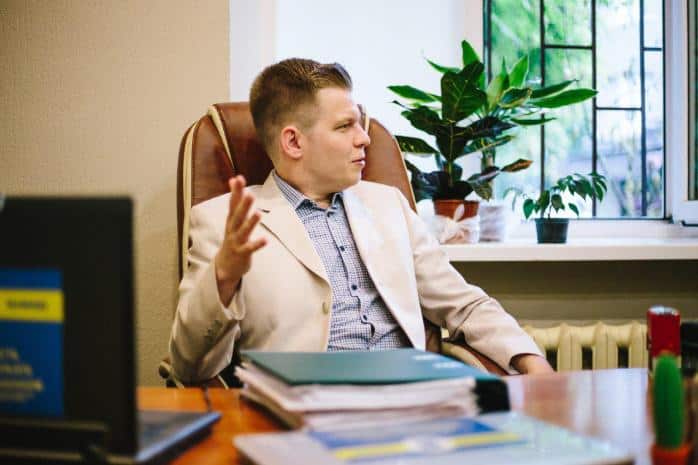
Alexander Shadrin, Partner at BARRISTERS, LLC: Sometimes lawyers say they would never defend murderers, but such a charge could be brought against anyone.
A series of talks with prominent Ukrainian lawyers who have dedicated decades to their profession, “Rakurs” has decided to continue the series with representatives of the new generation (and the region following Kyiv and Lviv). The first of them is Oleksandr Shadrin, a partner at BARRISTERS JSC and a lawyer.
He came to the legal profession from the investigative branch. He doesn’t miss his old job; he seems genuinely passionate about his current one. It’s not just interest—it’s a passion that emerges from behind his natural reserve only after about an hour of conversation.
His resume already includes a list of high-profile cases that not everyone manages to accumulate even over a much longer career.
Most of the cases handled by Oleksandr Shadrin vividly reflect both the spirit of the times and the specific character of the region—Kharkiv, which has now become a frontline city but has always, since the days of the Soviet Union, had a well-deserved reputation as a “police city,” a term that simply sounds a bit harsher.
Speaking about Oleksandr Shadrin, the head of the SBU, while listing his clients on air (who, incidentally, mostly came to the young lawyer through the pro bono legal aid program), pointedly suggested that viewers draw their own conclusions—what kind of lawyer is this, whose clients are “the wrong kind of people”?
Not every defense attorney is honored with direct publicity from the head of a security service who is unaware that associating a lawyer with his client is prohibited by law. Well, the head of the SBU is far from the only one guilty of this. In society—and not just ours—there is a widespread belief that a lawyer and their client are one and the same. The fact that everyone has the right to a defense is only mentioned when family members or friends get into trouble—who, of course, are a priori “innocent of any wrongdoing.”
— Oleksandr, do these associations with your clients bother you, especially when they come from the head of the SBU, for example, who directly insinuated that you’re a “separatist lawyer”?
— On the contrary, I’m actually pleased when officials of that level mention my name.
— In any context, as they say, except for an obituary?
— Of course, because in any case, all of this is excellent PR and a kind of acknowledgment that the attorney doesn’t sit well with the opponent, and therefore is doing his job well.
When a criminal case is accompanied by a flood of negative public information—including from high-ranking officials—and strong media support, it almost always turns out that the cases lack real evidence.
Evidence of such acknowledgment also includes genuine interest in the form of external surveillance, wiretapping, and searches.
- Is this about you, too?
- Yes. Generally speaking, there’s a pattern: when a criminal case is accompanied by a flood of negative public information—including from high-ranking officials—along with strong media support and numerous media reports, it almost always turns out that there is no real evidence in the case. And so they’re simply trying to bolster an accusation that relies exclusively on public opinion—which isn’t inclined to delve into the substance of the matter—and on the media buzz.
— A significant number of your cases involve specific charges—such as terrorism or threats to national security. How did this specialization come about?
— It just sort of happened historically. I began practicing as a lawyer in Kharkiv in 2012. Within just two years, a huge number of cases related to the conflict in the East emerged. Most of them are heard in Kharkiv for territorial reasons. Gradually, this specialization took shape—crimes related to terrorism. I really don’t know if there’s another lawyer who has handled as many terrorism-separatism cases as I have. And the reason for this isn’t just geography—not everyone is willing to take on such cases.
At the same time, these cases are very diverse. A real-life example: a repost on Facebook or VKontakte is treated as an encroachment on territorial integrity. And a 19-year-old mother of a young child was sent to pretrial detention. The case was transferred to Chuguev. Once every two months, the judge summons the suspect to extend the pretrial detention. That’s it—stay in pretrial detention until you confess.
By the way, it’s interesting that, for example, investigating judges in France don’t consider any cases on their merits at all. As a result, they aren’t biased toward prosecution and don’t throw everyone in jail indiscriminately, working in a truly objective and impartial manner. This is in contrast to how things happen here.
Three years ago, my car was set on fire because of another case I’m also handling as part of my pro bono legal work. Since these incidents are connected, there is evidence—both circumstantial and direct—from people who know who did it.
So why are the lawyer and the client being equated? Most likely, this is a consequence of the public’s legal nihilism. In fact, I have many ATO veterans among my clients; it’s just that these aren’t the high-profile cases that everyone is interested in. Or, for example, the case of Hero of Ukraine Nadiya Savchenko, whose patriotism no one doubts. However, the charges brought against her are typical of “separatist cases.”
Author: Alexander Shadrin
Source: