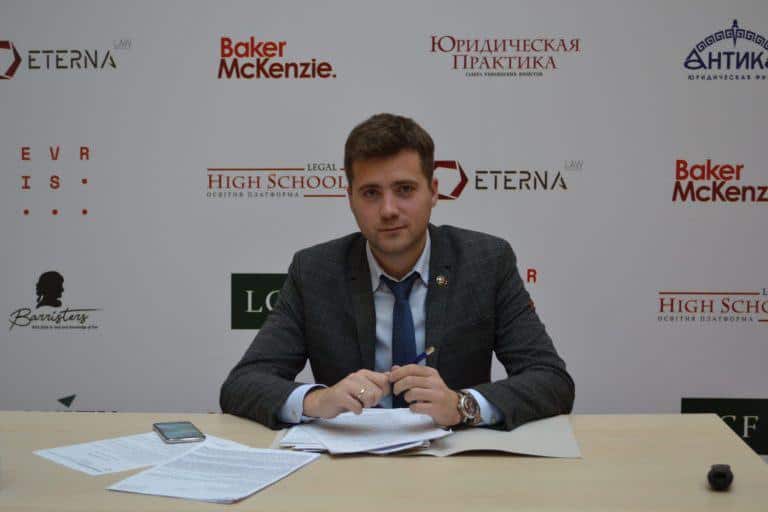
"Crimes Against Justice" – the topic of a lecture by Alexander Tananakin, an attorney at BARRISTERS, LLC
The “Crimes Against Justice” module of the School of Criminal Practice on the LHS educational platform opened with a lecture by Alexander Tananakin, an attorney at Barristers JSC, who discussed case law regarding the application of Articles 376, 377–379 of the Criminal Code of Ukraine, which list such crimes and establish liability for them.
If a judge is subjected to pressure, he or she has the right to file a complaint with the High Council of Justice (HCJ) regarding interference in the administration of justice or threats directed at him or her. The HJC receives about 100 such statements from judges each month, but there are no real mechanisms in place to protect judges. Interestingly, the HJC forwards these complaints to the Office of the Prosecutor General, but it is the staff of the Prosecutor General’s Office who, for the most part, are the ones exerting pressure on judges. Thus, the cycle continues, and judges remain unprotected.
“Insistent requests” from law enforcement agencies and threatening text messages are among the mildest forms of pressure. There have been cases where judges were threatened with the abduction of their family members if they did not hand down the desired verdict. Or psychological pressure was applied—a gallows was brought into the judge’s yard.
If a case attracts significant public attention, pressure on the judge is exerted by members of parliament or civic activists who disagree with the verdict. The activities of such “activists” are clearly coordinated by law enforcement agencies, since their actions—aimed at disrupting court proceedings—are never stopped.
It is not uncommon for the prosecution to demonstrate its legal incompetence, and thus be unable to counter a competent defense by the attorney. If a representative of the prosecution sees that the decision will not be in their favor, they seek to prevent a verdict from being handed down altogether by requesting the recusal or voluntary recusal of the judge. The case is then sent for retrial. The process drags on for years, and the suspect remains in custody the entire time. Eventually, the suspect files a complaint with the European Court of Human Rights (ECHR), and the ECHR rules in his favor, finding the court—not the prosecution, which exerts pressure on judges by disrupting the trial—at fault.
To prevent a judge from issuing an acquittal, the prosecution may even initiate criminal proceedings against such a principled judge. The lecturer cited examples of real-life situations involving non-procedural pressure on the court, emphasizing that differing interpretations of legal norms by prosecutors and defense attorneys lead to accusations that a judge has received an unlawful benefit when imposing a more lenient pretrial measure. Any decision by a judge that does not align with the prosecution’s position is, a priori, considered unlawful by the prosecutor.
Statistics on pressure against judges: In 2017, 517 criminal proceedings were initiated against judges on various charges, but only three cases reached trial (as a result of these trials, one person was convicted and two were acquitted). In 2018, 396 criminal cases were opened against judges, but only one was referred to court for trial.
“A judge’s appeal to the High Council of Justice with a complaint of pressure indicates that this judge is honest and courageous; however, such complaints raise doubts about the independence of the judiciary in general,” emphasized Oleksandr Tananakin.
In the history of the Ukrainian judiciary in recent years, only five cases have been identified under articles of the Criminal Code that provide for liability for crimes against judges. The lecturer analyzed these cases and expressed the opinion that in one instance, the matter did not involve interference with the court’s proceedings or an attempt on the judge’s life, but rather, most likely, acts of hooliganism, for which the perpetrator was convicted.
In another case, an attempt was made on a judge’s life by a group of individuals wearing camouflage and balaclavas; however, the suspect was acquitted by the court because the attacker could not be identified. The lecturer believes that such leniency on the part of the court may encourage further unlawful actions against judges.
However, in a case where the father of the defendant threatened a judge during a court hearing, he was sentenced to two years in prison, although, in the lecturer’s opinion, a fine alone would have sufficed. On the other hand, when judges were threatened with a knife and even suffered minor bodily injuries, the perpetrator was sentenced to only one year.
Cases of interference with the court’s electronic document management system are being recorded with increasing frequency, resulting in numerous forged court decisions, particularly in property cases. The fabrication of such decisions has already become a business of sorts, but only one verdict has been handed down so far.
Author: Lеgal High School
Source: